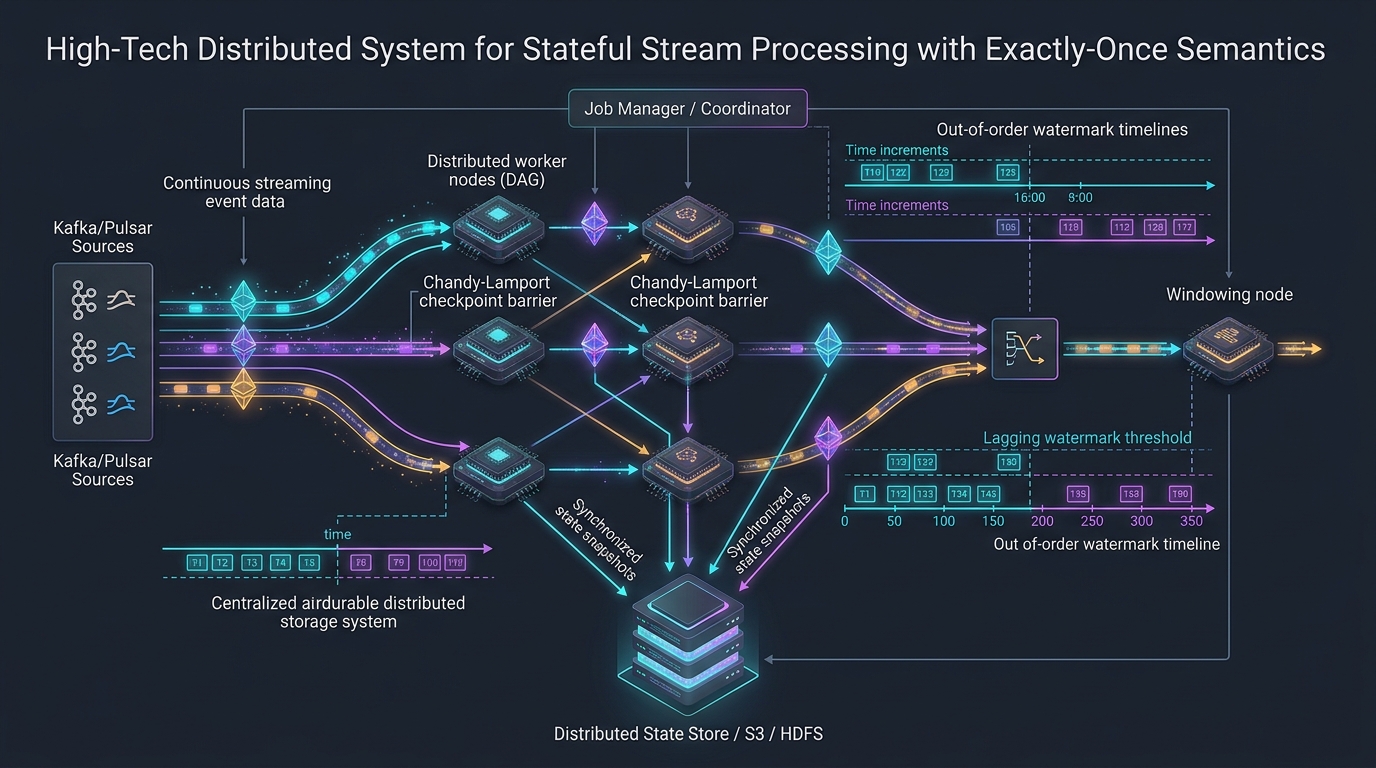
In high-scale distributed systems processing millions of events per second, Apache Kafka is the foundational backbone. Yet, despite widespread operational adoption, a persistent paradox confuses many engineers: how does a distributed log written in Java and running on top of magnetic disks or standard EBS volumes achieve throughput that outperforms in-memory messaging systems?
The answer lies in mechanical sympathy with the Linux operating system. Kafka avoids maintaining complex in-JVM memory caches or performing random disk seeks. Instead, it relies on sequential append-only disk I/O, the Linux OS PageCache, and hardware-accelerated Zero-Copy data transfers via the sendfile(2) system call.
In this architectural guide, we dissect the internal storage engine of Kafka brokers, analyze network socket mechanics, compare consumer partition rebalance protocols, and trace the cryptographic transaction coordinators behind Exactly-Once Semantics (EOS).
---1. Storage Engine Mechanics: Sequential I/O & The Linux PageCache
Traditional databases store records in B-trees or hash indexes that incur random I/O seeks across disk blocks. Modern NVMe SSDs provide high random IOPS, but sequential throughput remains 3x to 5x faster; on spinning rust or network-attached block storage (AWS EBS gp3), sequential writes are orders of magnitude faster.
1.1. Append-Only Commit Logs
A Kafka partition is physically stored on disk as a directory containing ordered segment files (e.g. 00000000000000000000.log). New messages are strictly appended to the end of the active segment file. Because writes are sequential, disk head movement is negligible.
1.2. The PageCache vs JVM Garbage Collection
Most Java applications allocate large heaps (32GB+) to cache data in memory. This introduces two major problems:
- Garbage Collection Pauses: Managing millions of small Java objects in heap memory triggers catastrophic Stop-the-World (STW) GC pauses that destroy low-latency SLAs.
- Double Caching: The OS kernel automatically caches recently written file pages in the Linux PageCache, duplicating memory usage.
Kafka bypasses this completely by running with a tiny JVM heap (4GB–8GB) and letting the Linux OS PageCache manage all caching. When a consumer reads messages produced seconds earlier, the data is served directly from RAM without touching physical disk platters or triggering JVM GC.
---2. Zero-Copy Network Transfer via sendfile(2)
In a standard network application, transferring data from disk to a network socket requires four context switches and four buffer copies:
Traditional File Transfer:
1. Disk ──(DMA Copy)──> OS PageCache
2. OS PageCache ──(CPU Copy)──> User-Space Application Buffer [Context Switch: Kernel -> User]
3. User Buffer ──(CPU Copy)──> OS Socket Buffer [Context Switch: User -> Kernel]
4. Socket Buffer ──(DMA Copy)──> NIC Network Buffer
Copying data back and forth across the user-space boundary wastes massive CPU cycles and pollutes the CPU L1/L2 caches.
The Zero-Copy Path
Kafka utilizes the Java NIO FileChannel.transferTo() method, which compiles directly to the Linux sendfile(2) system call:
Zero-Copy Transfer:
1. Disk ──(DMA Copy)──> OS PageCache
2. OS PageCache ──(DMA Scatter-Gather Copy)──> NIC Network Buffer directly!
Data moves directly from OS PageCache memory to the Network Interface Card (NIC) via Direct Memory Access (DMA). The CPU performs zero data copying, enabling a single Kafka broker to saturate 40Gbps and 100Gbps network interfaces with near-zero CPU utilization.
---3. Consumer Group Partition Rebalancing Protocols
When consumer instances join, leave, or crash within a consumer group, partitions must be redistributed across surviving members. Kafka's rebalancing architecture has undergone a radical evolutionary upgrade:
| Rebalance Protocol | Strategy | Consumer Impact | Stop-the-World? |
|---|---|---|---|
| Eager Rebalancing | All consumers revoke all assigned partitions simultaneously, rejoin group, and await reassignment. | Processing halts globally across all partitions during rebalance. | Yes (Full Stop) |
| Cooperative Sticky Rebalancing | Consumers retain assigned partitions. Only partitions being reassigned to new members are revoked in phases. | Unchanged partitions continue consuming and processing without pause. | No (Incremental) |
Enabling Cooperative Rebalancing
To prevent costly consumption freezes in production consumer fleets, configure the cooperative sticky assignor:
partition.assignment.strategy=org.apache.kafka.clients.consumer.CooperativeStickyAssignor4. Exactly-Once Semantics (EOS) Internals
Guaranteed message delivery in distributed systems traditionally fell into two modes: At-Most-Once (messages can be lost) or At-Least-Once (duplicates can occur). Kafka achieves true Exactly-Once Semantics (EOS) across consume-transform-produce pipelines through two interlocking mechanisms:
4.1. Idempotent Producers
Each producer is assigned a 64-bit Producer ID (PID) by the broker. For every message sent to a partition, the producer increments a monotonically increasing Sequence Number. The broker stores the highest committed sequence number for each PID. If a network timeout causes a retry and the broker receives a duplicate sequence number, it discards the message while acknowledging receipt, eliminating duplicate writes transparently.
4.2. Transactional Coordinator and Markers
For multi-partition transactions, Kafka introduces a dedicated Transaction Coordinator and an internal __transaction_state log:
// Java Transactional Producer
producer.initTransactions();

try {
    producer.beginTransaction();
    producer.send(new ProducerRecord<>("orders", orderId, orderData));
    producer.sendOffsetsToTransaction(consumerOffsets, consumerGroupId);
    producer.commitTransaction();
} catch (ProducerFencedException | OutOfOrderSequenceException e) {
    producer.close();
} catch (KafkaException e) {
    producer.abortTransaction();
}
When commitTransaction() executes, the coordinator writes a commit marker directly into the partition logs. Downstream consumers configured with isolation.level=read_committed filter out uncommitted messages and aborted transactions, ensuring atomic end-to-end processing.
5. Architecture Summary
By shifting caching to the Linux PageCache, eliminating memory copy overhead with sendfile(2), and implementing cooperative incremental partition rebalances, Apache Kafka provides unmatched data streaming efficiency. Understanding these mechanical internals enables infrastructure teams to size clusters accurately, eliminate latency anomalies, and design bulletproof distributed event pipelines.