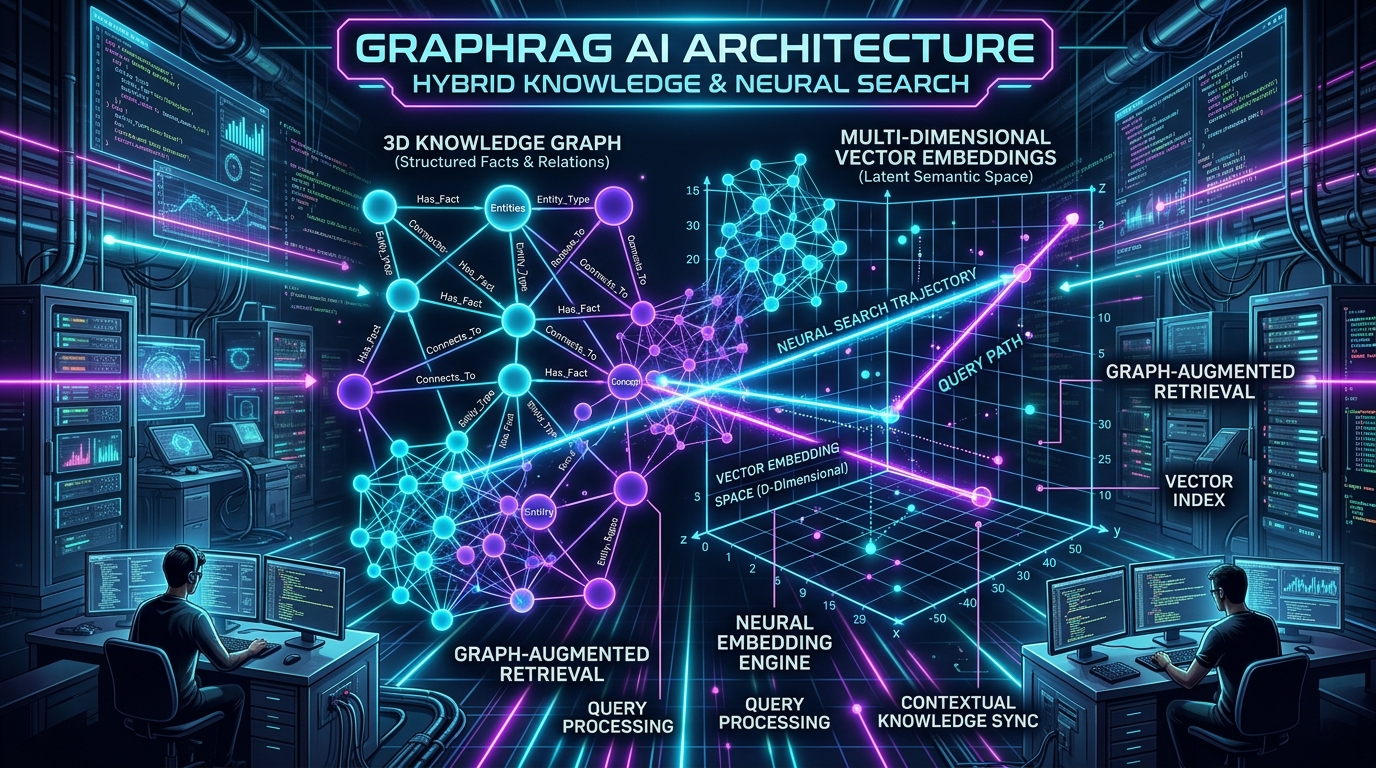
In the first generation of Generative AI applications, Retrieval-Augmented Generation (RAG) became the standard architectural pattern for grounding Large Language Models (LLMs) on private enterprise datasets. Standard RAG pipelines chunked documents, generated dense vector embeddings, and fetched the top-k most similar chunks via cosine similarity.
However, as production datasets scale to millions of tokens, engineering teams are running into the Vector Search Ceiling. Flat vector similarity is remarkably effective at answering direct, localized lookup questions (e.g., "What is the refund policy deadline?"), but it completely breaks down when tasked with multi-hop relationship traversal or holistic dataset summarization.
GraphRAG (Knowledge-Graph-Augmented RAG) solves this fundamental limitation. By extracting structured Entity-Relationship-Claim graphs from unstructured text and clustering them using hierarchical community detection algorithms, GraphRAG enables LLMs to perform multi-hop reasoning and high-level dataset synthesis with unprecedented accuracy.
In this guide, we explore the architectural mechanics of GraphRAG, analyze why flat vector search fails on complex relationships, and walk through how to build a production Hybrid Graph + Vector Retrieval Engine.
The 2 Fatal Blind Spots of Naive Vector RAG
To understand why Knowledge Graphs are necessary, examine the two failure modes that plague standard vector databases (such as Pinecone, Qdrant, or pgvector):
| Failure Mode | User Query Example | Why Flat Vector Search Fails |
|---|---|---|
| 1. Multi-Hop Traversal Failure | "Which downstream microservices are affected if we deprecate the OAuth auth module?" | The relevant dependencies are scattered across 15 separate documentation chunks that share zero semantic vector similarity with the word "deprecate". |
| 2. Global Dataset Synthesis Failure | "What are the top 5 systemic architectural risks across this entire repository?" | Top-k vector search randomly samples a few arbitrary local files, completely missing dataset-wide themes and macro patterns. |
The GraphRAG Architecture: From Unstructured Text to Knowledge Graphs
GraphRAG operates by transforming raw document chunks into a structured, interconnected graph network during the indexing pipeline:
+-------------------------------------------------------------------------+
|                        GRAPHRAG INGESTION PIPELINE                      |
|                                                                         |
|  +-------------------+      +---------------------------------------+   |
|  | Unstructured Text | ---> | Text Chunking (600 token windows)     |   |
|  +-------------------+      +---------------------------------------+   |
|                                                 |                       |
|                                                 v                       |
|                             +---------------------------------------+   |
|                             | LLM Entity & Relationship Extraction   |   |
|                             |  - Entities: Nodes (Service, Class)   |   |
|                             |  - Relationships: Edges (calls, owns) |   |
|                             |  - Claims / Facts: Edge attributes    |   |
|                             +---------------------------------------+   |
|                                                 |                       |
|                                                 v                       |
|                             +---------------------------------------+   |
|                             | Hierarchical Community Detection      |   |
|                             | (Leiden Algorithm: Level 0 -> Level 2)|   |
|                             +---------------------------------------+   |
|                                                 |                       |
|                                                 v                       |
|                             +---------------------------------------+   |
|                             | Pre-Computed Community Summaries      |   |
|                             | (High-level abstract per cluster)     |   |
|                             +---------------------------------------+   |
|                                                 |                       |
|                    +----------------------------+-----------------------+
|                    |                                                    |
|                    v                                                    v
|  +-----------------------------------+  +----------------------------+  |
|  |           GRAPH DATABASE          |  |       VECTOR STORE         |  |
|  | (Neo4j / Memgraph / FalkorDB/AGE) |  |   (pgvector / Qdrant)      |  |
|  +-----------------------------------+  +----------------------------+  |
+-------------------------------------------------------------------------+
The 2 Retrieval Modes: Local Search vs. Global Search
Unlike standard RAG which only has one search mechanism, GraphRAG provides two complementary retrieval strategies depending on the user's intent:
1. Local Search (Entity-Centric Reasoning)
Used for answering detailed questions about specific components or entities:
- Extract named entities from the user prompt (e.g.,
"BillingWorker"). - Locate the corresponding nodes in the Knowledge Graph.
- Traverse 1-to-3 degrees of separation (
k-hoprelational traversal) to extract connected neighbors, edges, and supporting raw text chunks. - Pass the unified sub-graph context to the LLM for synthesis.
2. Global Search (Macro Dataset Synthesis)
Used for answering high-level questions across the entire corpus:
- Identify the top-level Leiden Community Clusters in the graph.
- Execute a parallel Map-Reduce prompt across all community summaries (generating intermediate answers per cluster).
- Filter and re-rank intermediate cluster insights by relevance score.
- Synthesize the global final answer from the accumulated community summaries.
Hands-On Implementation: Entity Extraction & Cypher Graph Querying
1. Structured Extraction Prompt
During the ingestion phase, every text chunk is analyzed by an LLM to produce structured JSON nodes and relationships:
{
  "entities": [
    {
      "name": "PaymentService",
      "type": "MICROSERVICE",
      "description": "Handles Stripe and PayPal transaction processing."
    },
    {
      "name": "PostgresDB",
      "type": "DATABASE",
      "description": "Primary transactional relational store for billing records."
    }
  ],
  "relationships": [
    {
      "source": "PaymentService",
      "target": "PostgresDB",
      "relation": "WRITES_TRANSACTIONS_TO",
      "weight": 0.95,
      "description": "Executes atomic ledger inserts during checkout."
    }
  ]
}
2. Multi-Hop Graph Traversal with Cypher (Neo4j / Memgraph)
Once entities are ingested into a graph database, complex dependency questions are resolved in under 2 milliseconds using native graph traversal:
// Find all cascading dependencies 2-hops away from PaymentService
MATCH path = (start:Entity {name: "PaymentService"})-[r:RELATION*1..2]->(target:Entity)
RETURN
    start.name AS Source,
    [rel IN relationships(path) | type(rel)] AS RelationshipTypes,
    target.name AS ImpactedEntity,
    target.description AS Details
ORDER BY length(path) ASC;
Architecture Comparison: Naive RAG vs. Hybrid vs. GraphRAG
| Capability | Naive Vector RAG | Hybrid (BM25 + Vector) | GraphRAG (Knowledge Graph + Vector) |
|---|---|---|---|
| Direct Fact Lookup | Excellent | Excellent | Excellent |
| Multi-Hop Reasoning | Poor (Fails across files) | Fair | State of the Art (>90% accuracy) |
| Dataset-Wide Synthesis | Incapable | Incapable | Native via Community Summaries |
| Indexation Cost | $ (Embedding only) | $ (Embedding + BM25) | $$$ (Requires LLM entity extraction) |
Summary
While standard vector RAG remains adequate for simple search bars, enterprise AI systems dealing with complex codebases, regulatory legal documents, and intricate system architectures require GraphRAG. By uniting the unstructured nuance of vector embeddings with the deterministic precision of knowledge graphs, you eliminate hallucinations and unlock true multi-hop intelligence.