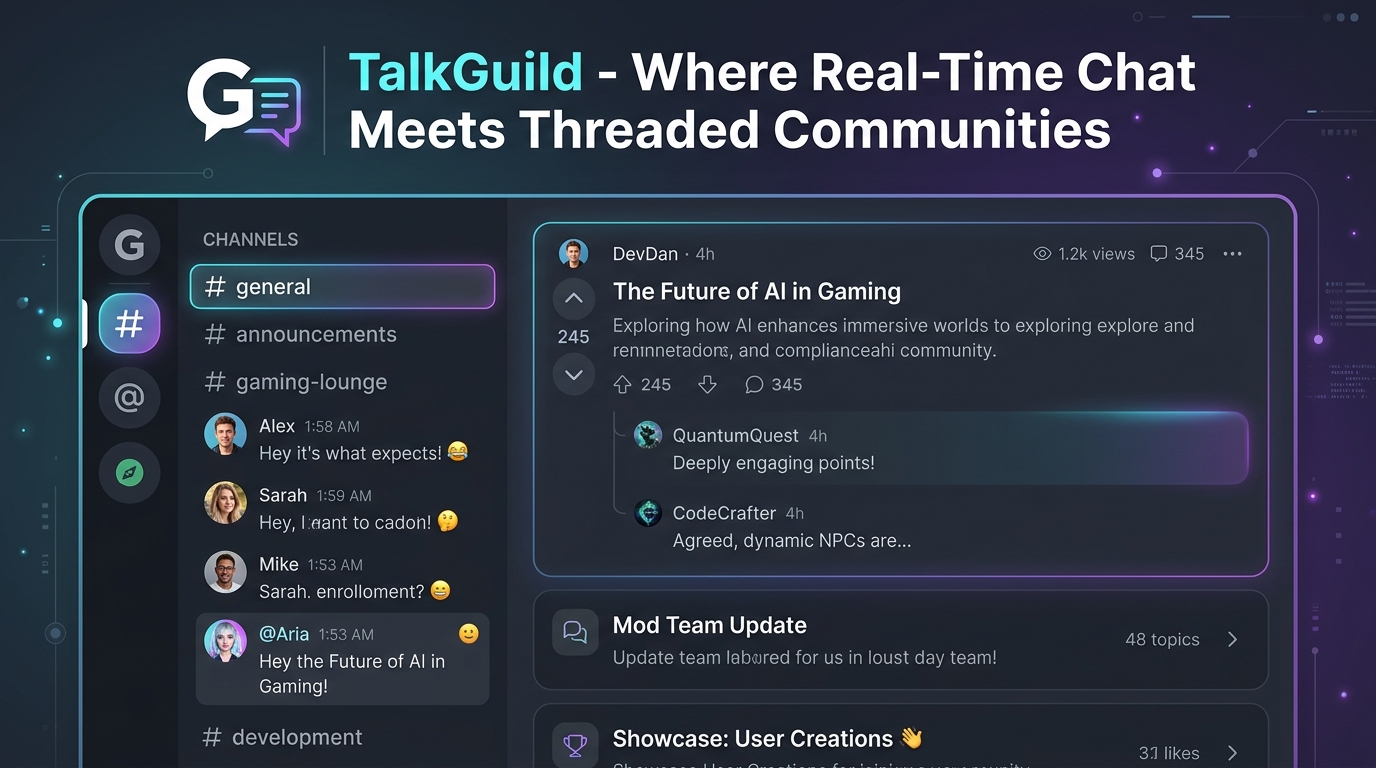
For years, developer communities, gaming clans, and creator hubs have faced a frustrating platform split: Discord for rapid, ephemeral real-time chatter, and Reddit or legacy forums for searchable, persistent, nested discussions. Running both platforms fragments community attention, duplicates moderation overhead, and siloes valuable technical knowledge.
Building a unified platform that solves this divide—such as the newly launched TalkGuild—requires solving two radically different engineering paradigms under a single roof: high-throughput, sub-millisecond push messaging for live chat channels, and hierarchical, deeply nested, score-ranked relational data for threaded discussion boards.
In this technical deep-dive, we break down the end-to-end software architecture behind building and scaling a modern hybrid community platform: from WebSocket connection multiplexing and Redis Pub/Sub fan-out, to recursive SQL comment trees and concurrency-safe voting algorithms.
The Architectural Impedance Mismatch: Chat vs. Forums
The core difficulty in uniting chat and forums stems from their opposite operational profiles and data access patterns:
| Dimension | Live Chat Channels (Discord-Style) | Threaded Forum Boards (Reddit-Style) |
|---|---|---|
| Primary Access Pattern | Write-heavy, real-time push to connected clients | Read-heavy, complex sorted and filtered queries |
| Data Structure | Flat, append-only chronological log per channel | N-ary hierarchical tree (recursive parent-child nodes) |
| Latency Expectation | Sub-50ms round-trip delivery (WebSocket / TCP) | 100–300ms page load with edge caching / SSR |
| Ephemeral State | Typing indicators, presence, voice state | None (or periodic viewer count) |
| Ranking & Sorting | Strict chronological (ORDER BY timestamp ASC) |
Multi-factor: Hot, Top, New, Wilson score intervals |
When you unify these in a system like TalkGuild, your backend must seamlessly switch between streaming duplex sockets and structured relational indexing while sharing a unified identity, permission, and tenancy layer.
1. Sub-Millisecond Real-Time Chat Infrastructure
Live text channels cannot rely on HTTP polling. The messaging layer requires a persistent bidirectional transport (WebSockets) paired with a high-throughput pub/sub cluster (Redis Pub/Sub or Redis Streams) to broadcast messages across horizontally scaled worker nodes.
Connection Lifecycle and Guild Multiplexing
Rather than establishing separate WebSocket connections for every channel a user navigates to, the client establishes a single authenticated socket connection to the gateway cluster. Subscriptions to specific guild channels are multiplexed through socket room topics:
// Gateway Connection & Multiplexed Channel Subscription
interface SocketPayload {
  event: 'subscribe_channel' | 'unsubscribe_channel' | 'chat_message' | 'typing_start';
  guildId: string;
  channelId?: string;
  data?: any;
}

// Client subscribes dynamically as they view channels
socket.emit('subscribe_channel', {
  guildId: 'guild_9a8f2c',
  channelId: 'chan_general_01'
});
Redis Pub/Sub Horizontal Fan-Out
When User A sends a message to #general on Guild 1, Server Node A receives the frame, validates permissions against the cache, commits the message to PostgreSQL, and publishes the event to Redis:
// Publishing message to cluster broker
const channelKey = `guild:${guildId}:channel:${channelId}:events`;

await redisPublisher.publish(channelKey, JSON.stringify({
  type: 'NEW_MESSAGE',
  message: {
    id: messageId,
    guildId,
    channelId,
    author: { id: user.id, username: user.name, avatar: user.avatarUrl },
    content: sanitizedContent,
    createdAt: new Date().toISOString()
  }
}));
All connected gateway nodes subscribed to guild:*:events receive the broadcast and push the payload directly down to active WebSocket clients inside the channel room. This ensures sub-10ms inter-server delivery regardless of which physical container hosts each client.
Handling Ephemeral Events: Typing Indicators & Optimistic UI
Typing indicators are high-frequency, non-durable events. Writing them to a database would exhaust I/O. Instead, typing events bypass the database entirely:
- Client emits
typing_startwith a 3-second debounce. - Gateway server pushes the event to the Redis channel with a 4-second TTL.
- Clients render typing bubbles and automatically fade them after 3.5 seconds if no renew event is received.
2. High-Performance Nested Forum Trees
In contrast to the flat append-only log of a chat room, discussion boards require nested comment trees of arbitrary depth (Reddit-style threads), where replies can branch off any parent comment.
Comparing Tree Data Models
There are three primary strategies for storing hierarchical comment trees in relational databases:
| Pattern | Write Cost | Fetch Whole Tree | Fetch Sub-Branch |
|---|---|---|---|
| Adjacency List + Recursive CTE | O(1) – Simple parent_id |
Fast with Indexed (post_id, parent_id) |
Fast via Recursive Query |
Materialized Path (LTree) |
O(1) – Path string concatenation | Fast via B-Tree / GIST prefix match | O(1) – path LIKE '1.4.%' |
| Closure Table | O(depth) – N rows per insert | Very fast JOIN query | Very fast JOIN query |
Querying Nested Trees with Recursive CTEs in PostgreSQL
For modern PostgreSQL instances, an Adjacency List paired with a Recursive Common Table Expression (CTE) offers the optimal balance of zero write penalty and blazing-fast reads:
WITH RECURSIVE comment_tree AS (
    -- 1. Anchor member: Root comments (parent_id IS NULL)
    SELECT
        id,
        post_id,
        parent_id,
        user_id,
        content,
        score,
        created_at,
        1 AS depth,
        ARRAY[id] AS path
    FROM forum_comments
    WHERE post_id = :postId AND parent_id IS NULL

    UNION ALL

    -- 2. Recursive member: Child comments
    SELECT
        c.id,
        c.post_id,
        c.parent_id,
        c.user_id,
        c.content,
        c.score,
        c.created_at,
        ct.depth + 1,
        ct.path || c.id
    FROM forum_comments c
    INNER JOIN comment_tree ct ON c.parent_id = ct.id
    WHERE ct.depth < 15 -- Prevent runaway recursion
)
SELECT *
FROM comment_tree
ORDER BY path ASC;
The path array column accumulates parent IDs (e.g., {101, 104, 119}). Sorting by path ASC automatically returns comments in pre-order traversal order, allowing frontend clients to render the nested tree sequentially in a single pass without expensive recursion in JavaScript.
3. Instant Voting Pipeline and Hot-Ranking Algorithms
Discussion threads rely on upvotes and downvotes to curate the best technical solutions and community content. An effective voting architecture must satisfy three requirements: idempotency, concurrency safety, and deterministic score ranking.
Atomic Concurrency Control with Single-Statement Upserts
Naive "read-modify-write" vote calculations lead to lost updates under high concurrency. Instead, use atomic database upserts with conditional score adjustments:
-- Atomic Vote Toggle / Upsert
INSERT INTO forum_votes (user_id, post_id, direction, created_at, updated_at)
VALUES (:userId, :postId, :direction, NOW(), NOW())
ON CONFLICT (user_id, post_id)
DO UPDATE SET
    direction = EXCLUDED.direction,
    updated_at = NOW();

-- Update cached post score atomically
UPDATE forum_posts
SET
    upvotes_count = (SELECT COUNT(*) FROM forum_votes WHERE post_id = :postId AND direction = 1),
    downvotes_count = (SELECT COUNT(*) FROM forum_votes WHERE post_id = :postId AND direction = -1),
    score = (
        (SELECT COUNT(*) FROM forum_votes WHERE post_id = :postId AND direction = 1) -
        (SELECT COUNT(*) FROM forum_votes WHERE post_id = :postId AND direction = -1)
    )
WHERE id = :postId;
The "Hot" Time-Decay Ranking Formula
To prevent older high-scoring threads from permanently dominating the front page, TalkGuild and similar platforms employ logarithmic score decay:
-- Reddit-Style Hot Ranking in PostgreSQL
-- Score component uses base-10 logarithm; Time component decays over 45,000s (~12.5 hours)
CREATE OR REPLACE FUNCTION calculate_hot_score(score INTEGER, created_at TIMESTAMP WITH TIME ZONE)
RETURNS NUMERIC AS $$
DECLARE
    order_val NUMERIC;
    sign_val INTEGER;
    seconds NUMERIC;
BEGIN
    -- Determine sign of score
    IF score > 0 THEN
        sign_val := 1;
    ELSIF score < 0 THEN
        sign_val := -1;
    ELSE
        sign_val := 0;
    END IF;

    -- Logarithmic magnitude of score (diminishing returns on upvotes)
    IF ABS(score) >= 1 THEN
        order_val := LOG(10, ABS(score));
    ELSE
        order_val := 0;
    END IF;

    -- Seconds elapsed since epoch benchmark
    seconds := EXTRACT(EPOCH FROM created_at) - 1704067200; -- 2024-01-01 epoch

    RETURN ROUND((sign_val * order_val + seconds / 45000)::numeric, 7);
END;
$$ LANGUAGE plpgsql IMMUTABLE;
By creating an expression index on calculate_hot_score(score, created_at), the forum feed can query thousands of posts ordered by hot_score DESC in less than 2 milliseconds.
4. Unified Multi-Tenant Guild Architecture
To give users a unified community experience, all channels and forum boards reside under a single Guild context with centralized Role-Based Access Control (RBAC):
- Guild Scoping: Every channel (text, announcement, voice) and every forum board belongs to a
guild_idpartition. - Granular Permissions Bitmask: Roles carry permission bitmasks (e.g.,
SEND_MESSAGES = 1 << 3,CREATE_FORUM_POSTS = 1 << 12,MODERATE_THREADS = 1 << 15), allowing sub-microsecond permission checks in both WebSocket middleware and HTTP route guards. - Zero Context Switching: Members stay in the same interface: participating in a live debugging session in
#chatwhile simultaneously referencing a detailed solution on the guild's#discussionsboard.
Key Takeaways and Experiencing TalkGuild
Modern community platforms don't have to choose between ephemeral chat velocity and structured forum depth. By decoupling real-time event broadcasting to Redis/WebSockets while modeling hierarchical discussions with recursive SQL trees and logarithmic score decay, you achieve the best of both worlds with sub-10ms response times.
If you want to see this hybrid architecture in action, check out TalkGuild (talkguild.site)—create a custom guild or join public developer communities to experience live channels and threaded boards unified under one roof.