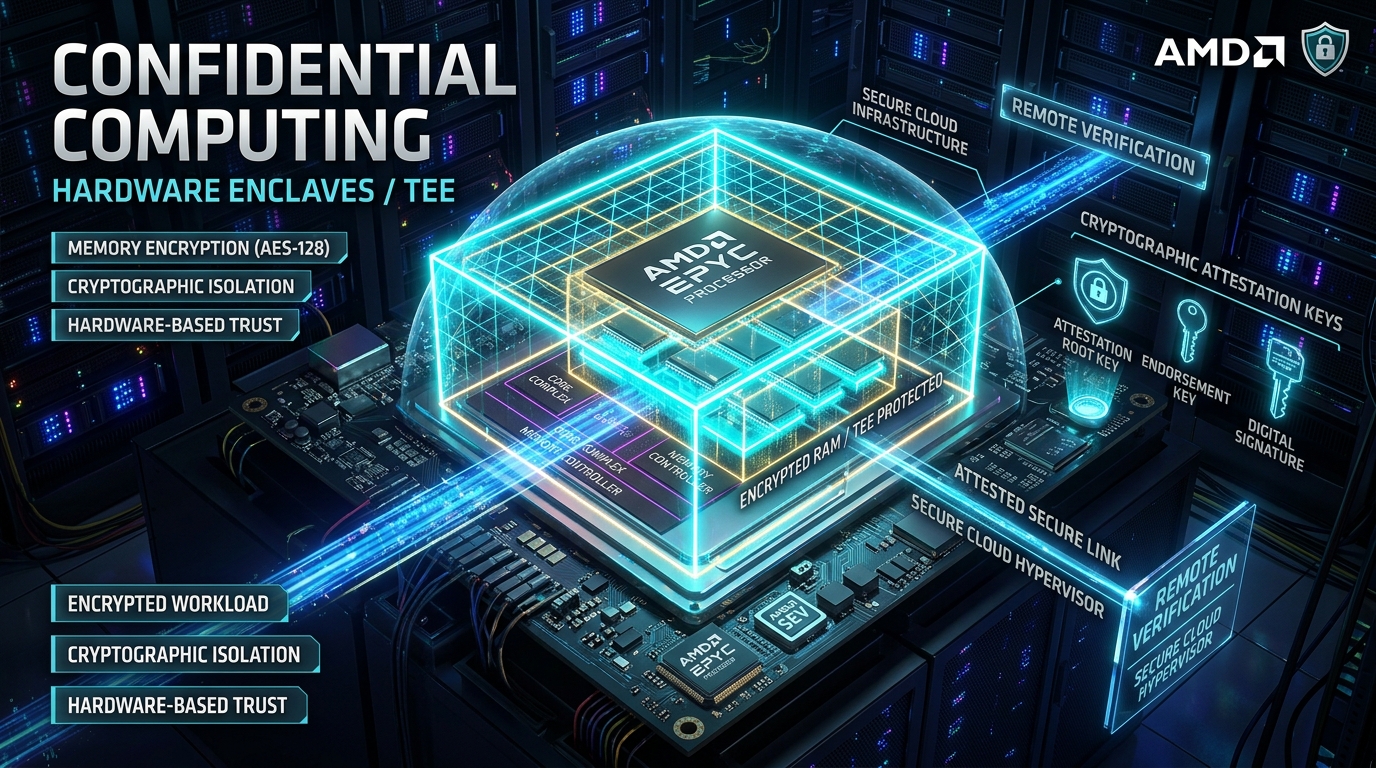
For decades, cloud security models operated on an uncomfortable implicit compromise. While organizations rigorously secured Data at Rest (via AES-256 disk encryption) and Data in Transit (via TLS 1.3), Data in Use—the plaintext data residing in system RAM while being actively processed by CPUs—remained completely exposed to the underlying cloud infrastructure.
Anyone with administrative access to the physical host, a compromised cloud hypervisor, or malicious neighbor processes in a multi-tenant environment could execute memory dumps (via /dev/mem, DMA attacks, or hypervisor introspection) to extract private encryption keys, plaintext database rows, and proprietary AI model weights.
Confidential Computing closes this final security frontier. By using hardware-rooted Trusted Execution Environments (TEEs), CPUs encrypt memory transparently at the silicon level and cryptographically prove to clients that their workloads are running in an un-tampered hardware enclave via Remote Attestation.
In this guide, we break down how hardware memory encryption works, compare modern enclave architectures (AMD SEV-SNP, Intel TDX, AWS Nitro Enclaves), explore the mechanics of cryptographic remote attestation, and demonstrate how to deploy zero-trust confidential workloads.
The 3 States of Data Security: The Missing Link
| Data State | Protection Mechanism | Security Scope | Vulnerability Vector |
|---|---|---|---|
| 1. Data at Rest | AES-256 / LUKS Disk Encryption | Protects stolen physical hard drives | Keys are loaded into plaintext RAM upon mount |
| 2. Data in Transit | TLS 1.3 / WireGuard VPN | Protects network wiretapping & MITM | Data is decrypted into plaintext memory at socket endpoints |
| 3. Data in Use (Confidential Computing) | Hardware TEE / Memory Controller Encryption | Protects memory from rogue hypervisors, cloud admins, and root hosts | Hardware-enforced zero-trust isolation |
How Hardware Enclaves Work: Silicon-Level Memory Encryption
In a standard server architecture, the memory controller writes raw data directly to DRAM chips. In a Confidential Computing environment (such as an AMD EPYC or Intel Xeon processor), a dedicated hardware cryptographic security co-processor is integrated directly on the CPU die:
+-------------------------------------------------------------------------+
|                        CONFIDENTIAL CPU DIE                             |
|                                                                         |
|  +-----------------------------------+  +----------------------------+  |
|  |     Confidential VM / Enclave     |  |     Untrusted Hypervisor   |  |
|  |    (Plaintext in CPU L1/L2/L3)    |  |       (KVM / QEMU / ESXi)  |  |
|  +-----------------------------------+  +----------------------------+  |
|                  |                                     |                |
|                  +------------------+------------------+                |
|                                     v                                   |
|                     ON-DIE MEMORY CONTROLLER & AES ENGINE               |
|            (Transparently encrypts with ephemeral hardware key)         |
+-------------------------------------+-----------------------------------+
                                      |
                                      v Encrypted Bus
                     +---------------------------------+
                     |     PHYSICAL DRAM MEMORY CHIP   |
                     |  (Stores ciphertext only: AES)  |
                     +---------------------------------+
- Data remains in plaintext only while inside the CPU core registers and L1/L2/L3 caches.
- Whenever cache lines are written out across the memory bus to DRAM, the hardware AES engine encrypts the block on the fly using an ephemeral key generated by the CPU security processor.
- Even if an attacker attaches physical oscilloscope probes to the DDR5 memory traces or takes a hypervisor snapshot, they observe only cryptographically random ciphertext.
Comparing Major Confidential Computing Technologies
| Technology | Vendor / Platform | Isolation Level | Key Architectural Advantage |
|---|---|---|---|
| AMD SEV-SNP | AMD EPYC (Milan / Genoa) | Full Confidential Virtual Machine (CVM) | Secure Nested Paging prevents memory replay, memory re-mapping, and side-channel tampering by hypervisors. |
| Intel TDX | Intel Xeon (4th/5th Gen) | Trust Domains (TD) | Hardware-isolated guest VMs with zero hypervisor privileges inside the Trust Domain. |
| AWS Nitro Enclaves | Amazon Web Services (EC2) | Isolated Virtual Environment | No persistent storage, no external IP networking, communicates strictly via local vsock. |
| NVIDIA Confidential GPUs | NVIDIA H100 / H200 / B200 | GPU VRAM & PCIe Enclave | Encrypts multi-gigabyte LLM model weights and inference tensor activations in GPU memory. |
Cryptographic Remote Attestation: The Zero-Trust Anchor
How does a client know that a remote cloud server is actually running in a verified hardware enclave rather than a simulated hypervisor trap? The answer is Cryptographic Remote Attestation:
+-------------------------------------------------------------------------+
|                    REMOTE ATTESTATION WORKFLOW                          |
|                                                                         |
|  1. Client sends challenge nonce to Enclave.                            |
|  2. Enclave generates an ephemeral keypair and asks CPU hardware        |
|     security processor for an Attestation Report.                       |
|  3. CPU Security Processor hashes the exact initial memory state       |
|     (Measurement / MRENCLAVE) and signs it with a factory-fused         |
|     hardware endorsement key (VCEK) signed by AMD / Intel / AWS PKI.    |
|  4. Client validates certificate chain up to AMD/Intel Root CA.         |
|  5. Only after measurement verification passes does the client release  |
|     master database decryption keys or proprietary code.                |
+-------------------------------------------------------------------------+
Hands-On: Validating Remote Attestation in Go
Here is how a backend microservice cryptographically verifies an AMD SEV-SNP attestation report before provisioning sensitive secrets:
// attestation_verifier.go
package main

import (
	"crypto/x509"
	"fmt"
	"github.com/google/go-sev-guest/abi"
	"github.com/google/go-sev-guest/verify"
)

func verifyEnclaveReport(rawReport []byte, expectedMeasurement []byte) error {
	// 1. Parse raw binary SEV-SNP attestation report
	report, err := abi.ReportFromProtoBytes(rawReport)
	if err != nil {
		return fmt.Errorf("failed to parse attestation report: %w", err)
	}

	// 2. Validate hardware signature against AMD Root Key Certificate
	opts := &verify.Options{
		Getter: verify.DefaultHTTPSGetter(),
	}
	if err := verify.SnpReport(report, opts); err != nil {
		return fmt.Errorf("cryptographic hardware signature invalid: %w", err)
	}

	// 3. Verify that the running binary matches the expected golden hash
	if string(report.Measurement) != string(expectedMeasurement) {
		return fmt.Errorf("binary tampering detected! MRENCLAVE mismatch")
	}

	fmt.Println("✅ Hardware enclave cryptographically verified! Memory is untampered.")
	return nil
}
Real-World Enterprise Use Cases
- Multi-Tenant SaaS Data Vaults: Isolating sensitive customer data so that even if a SaaS company's infrastructure is breached, individual tenant memory cannot be dumped.
- Confidential AI & LLM Serving: Running proprietary fine-tuned model weights on public cloud GPUs without exposing weights to cloud operators, and processing sensitive medical/financial prompts with mathematical privacy guarantees.
- Secure Multi-Party Computation (MPC): Enabling competing financial institutions or healthcare researchers to run collaborative analytics on pooled private datasets without either party seeing the other's raw data.
Summary
Confidential Computing represents the definitive realization of Zero-Trust Infrastructure. By elevating encryption from disk and network protocols into CPU hardware memory controllers and enforcing mathematical proof via Remote Attestation, engineering teams can build, deploy, and scale sensitive cloud workloads with absolute confidentiality guarantees.