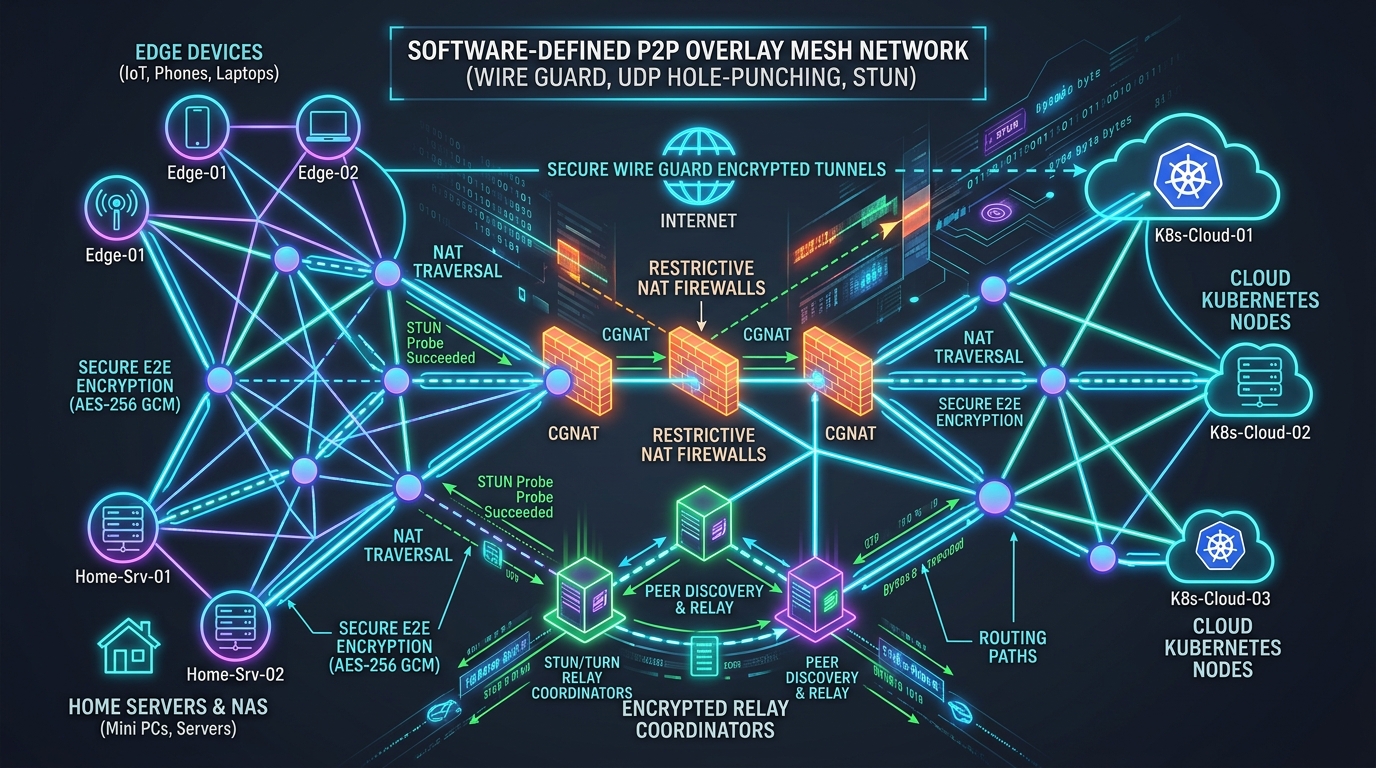
In the traditional enterprise networking model, private interconnectivity relied on Hub-and-Spoke VPNs (such as OpenVPN or IPsec). All client traffic—whether originating from a developer's laptop, an IoT edge gateway, or an on-premise database—was backhauled through a centralized corporate VPN concentrator.
This centralized architecture creates massive throughput bottlenecks, high latency dog-legs, single points of failure, and complex firewall maintenance. Worse, in a modern multi-cloud and remote-first world where workloads reside across AWS, GCP, homelabs, and 5G mobile devices, configuring static IP routes and opening inbound public firewall ports is an operational nightmare.
The industry has decisively transitioned to Software-Defined Peer-to-Peer Overlay Mesh Networks (popularized by platforms like Tailscale, NetBird, Nebula, and Headscale). By pairing WireGuard's modern cryptographic primitives with automated NAT Traversal (STUN, ICE, and UDP Hole Punching), mesh overlays establish direct, authenticated, end-to-end encrypted tunnels between any two devices on Earth—even when both devices reside behind restrictive Carrier-Grade NATs (CGNAT) and corporate firewalls.
In this technical guide, we dissect the internal architecture of software-defined overlay networks, analyze WireGuard Cryptokey Routing and the Noise Protocol, explore the physics of UDP Hole Punching across Full-Cone vs. Symmetric NATs, examine Encrypted Relay Fallbacks (DERP), and configure a working point-to-point WireGuard mesh in Go and Linux.
The Fundamental Problem: IPv4 Scarcity, Firewalls & CGNAT
Every internet-connected router implements a Stateful Packet Filter (Firewall) and Network Address Translation (NAT). An outbound packet from your private IP (e.g. 192.168.1.50:51820) creates an entry in the router's translation table mapping to a temporary public port (e.g. 203.0.113.10:48921).
If an unknown external IP attempts to send packets to that public port without prior outbound communication from your device, the firewall silently drops the packet. When both devices reside behind NATs or Carrier-Grade NATs (mobile/cellular networks), neither device possesses a reachable public IP.
The P2P NAT Traversal Dilemma:

Device A (Behind Home NAT / CGNAT)                 Device B (Behind Cloud VPC / NAT)
Private: 192.168.1.10:51820                        Private: 10.0.0.5:51820
Public:  203.0.113.42:38190                        Public:  198.51.100.88:42100
        │                                                  │
        ├─── Direct packet send: 198.51.100.88:42100 ────>X (DROPPED by B's Firewall!)
        │                                                  │
        X<── Direct packet send: 203.0.113.42:38190 ───────┤ (DROPPED by A's Firewall!)

Neither device can initiate an inbound connection! How do we connect them peer-to-peer?
The Physics of UDP Hole Punching & NAT Types
P2P overlay networks bypass firewalls using UDP Hole Punching coordinated via a lightweight public server (STUN: Session Traversal Utilities for NAT):
UDP Hole Punching Sequence:

1. Discovery Phase (via Public STUN Coordinator):
   • Device A sends UDP packet to STUN Server -> STUN responds: "You are 203.0.113.42:38190"
   • Device B sends UDP packet to STUN Server -> STUN responds: "You are 198.51.100.88:42100"
   • STUN Server exchanges mapped public endpoints between Device A and Device B!

2. Simultaneous Hole-Punching Flight:
   • Device A immediately sends UDP packet to 198.51.100.88:42100.
     (A's NAT router creates an outbound state entry expecting replies from 198.51.100.88!)
   • Device B simultaneously sends UDP packet to 203.0.113.42:38190.
     (B's NAT router creates an outbound state entry expecting replies from 203.0.113.42!)

3. Direct P2P Channel Established!
   • When B's packet hits A's router, A's router sees an existing state match and PERMITS it!
   • When A's packet hits B's router, B's router sees an existing state match and PERMITS it!
   • High-speed, direct, low-latency UDP stream is born with ZERO intermediate relaying!
The NAT Compatibility Matrix:
| NAT Type | Mapping Behavior | P2P Hole Punching Success Rate |
|---|---|---|
| Full-Cone / Endpoint-Independent | All outbound packets from same internal port map to same public port; any external host can reply. | 100% Direct P2P Success |
| Address-Restricted / Port-Restricted Cone | Same public port mapping, but only external hosts/ports previously messaged can send replies. | > 95% Direct P2P Success (via simultaneous punching) |
| Symmetric NAT (Hard NAT) | Every unique destination IP/Port creates a brand new random public port allocation. | Fails P2P Punching (Requires DERP / TURN Relay Fallback) |
Encrypted Relay Fallback: DERP (Designated Encrypted Relay for Packets)
When two devices encounter a Symmetric-to-Symmetric NAT combination (common on strict corporate enterprise firewalls and mobile LTE carriers), UDP hole punching is mathematically impossible because the predicted port mappings do not match.
Modern overlay networks solve this with DERP (Designated Encrypted Relay for Packets):
DERP Encrypted Relay Protocol:

[ Device A ] ────(TLS over TCP/HTTPS: Port 443)────> [ DERP Relay Server ] ────(TLS over TCP)────> [ Device B ]
(Encrypted) (Zero Knowledge!) (Encrypted)- Zero-Knowledge Security: Packets routed through DERP are end-to-end encrypted with the target node's WireGuard public key. The DERP relay server cannot inspect, decrypt, or tamper with the payload.
- Universal Firewall Traversal: DERP connects over standard HTTPS (TCP Port 443 / WebSockets), allowing connectivity across even the most restrictive enterprise proxies.
- Dynamic Probing: While traffic flows over DERP, nodes continuously send background UDP STUN probes; as soon as network conditions change (e.g. user leaves cellular and joins Wi-Fi), the connection automatically upgrades to direct P2P.
WireGuard Architecture: Cryptokey Routing & The Noise Protocol
Unlike legacy VPNs (OpenVPN's 100,000 lines of code or IPsec's complex IKEv2 daemon negotiation), WireGuard is less than 4,000 lines of verified C in the Linux kernel, built on the Noise Protocol Framework (Noise_IKpsk2):
WireGuard Cryptokey Routing Table:

Interface: wg0 (Private IP: 100.64.0.1/32, PrivateKey: a8f9...)

Peer 1:
  PublicKey:  xT8vK9... (Node: database-prod)
  Endpoint:   198.51.100.88:51820 (Discovered dynamically via STUN!)
  AllowedIPs: 100.64.0.2/32

Peer 2:
  PublicKey:  b2Z1pQ... (Node: worker-node-us-east)
  Endpoint:   203.0.113.14:48921
  AllowedIPs: 100.64.0.3/32, 10.0.0.0/24 (Subnet Route!)
Cryptokey Routing Invariant:
In WireGuard, there are no usernames, passwords, or certificate authorities. Public Keys ARE the network identity. When sending a packet to 100.64.0.2, WireGuard looks up the entry in its Cryptokey Routing table, encrypts the payload with Peer 1's public key (using ChaCha20-Poly1305), and transmits it to Peer 1's latest roaming UDP endpoint.
Hands-On: Building a Point-to-Point WireGuard Tunnel in Go
Below is a working Go implementation utilizing golang.zx2c4.com/wireguard (the official WireGuard Go user-space engine) demonstrating programmatically spinning up a TUN interface and configuring peer encryption keys:
package main

import (
	"fmt"
	"log"
	"net"
	"os"
	"os/signal"
	"syscall"

	"golang.zx2c4.com/wireguard/conn"
	"golang.zx2c4.com/wireguard/device"
	"golang.zx2c4.com/wireguard/ipc"
	"golang.zx2c4.com/wireguard/tun"
)

func main() {
	tunName := "wg-mesh0"
	port := 51820

	// 1. Create User-space TUN virtual network interface
	tunDev, err := tun.CreateTUN(tunName, device.DefaultMTU)
	if err != nil {
		log.Fatalf("Failed to create TUN device: %v", err)
	}
	defer tunDev.Close()

	// 2. Initialize WireGuard Device Logger and Bindings
	logger := device.NewLogger(device.LogLevelVerbose, fmt.Sprintf("(%s) ", tunName))
	dev := device.NewDevice(tunDev, conn.NewDefaultBind(), logger)
	defer dev.Close()

	// 3. Configure WireGuard IPC settings via User-space Configuration Protocol
	// In production, keys are generated via Curve25519 (wg genkey)
	config := fmt.Sprintf(`private_key=60a1b2c3d4e5f60718293a4b5c6d7e8f90123456789abcdef0123456789abcde
listen_port=%d
public_key=70b2c3d4e5f60718293a4b5c6d7e8f90123456789abcdef0123456789abcdef0
endpoint=203.0.113.88:51820
allowed_ip=100.64.0.2/32
persistent_keepalive_interval=25
`, port)

	ipcErr := dev.IpcSet(config)
	if ipcErr != nil {
		log.Fatalf("Failed to configure WireGuard device: %v", ipcErr)
	}

	dev.Up()
	log.Printf("WireGuard Mesh Interface '%s' is UP and listening on UDP port %d", tunName, port)

	// Wait for termination signal
	sigChan := make(chan os.Signal, 1)
	signal.Notify(sigChan, syscall.SIGINT, syscall.SIGTERM)
	<-sigChan

	log.Println("Shutting down WireGuard interface...")
}
Summary & Engineering Checklist
- Eliminate Legacy VPN Chokepoints: Replace centralized Hub-and-Spoke VPN concentrators with decentralized peer-to-peer WireGuard mesh overlays.
- Rely on STUN for Direct P2P: Use lightweight UDP STUN coordinators to discover external NAT mappings and achieve direct line-rate connectivity for $>90\%$ of traffic.
- Deploy DERP Relays for 100% Reliability: Always pair P2P mesh overlays with globally distributed, zero-knowledge HTTPS relay servers (DERP) to guarantee connectivity when traversing restrictive symmetric firewalls.
- Embrace Zero Trust Identity: Anchor access control to cryptographic public keys (Cryptokey Routing) rather than dynamic, ephemeral IP addresses.