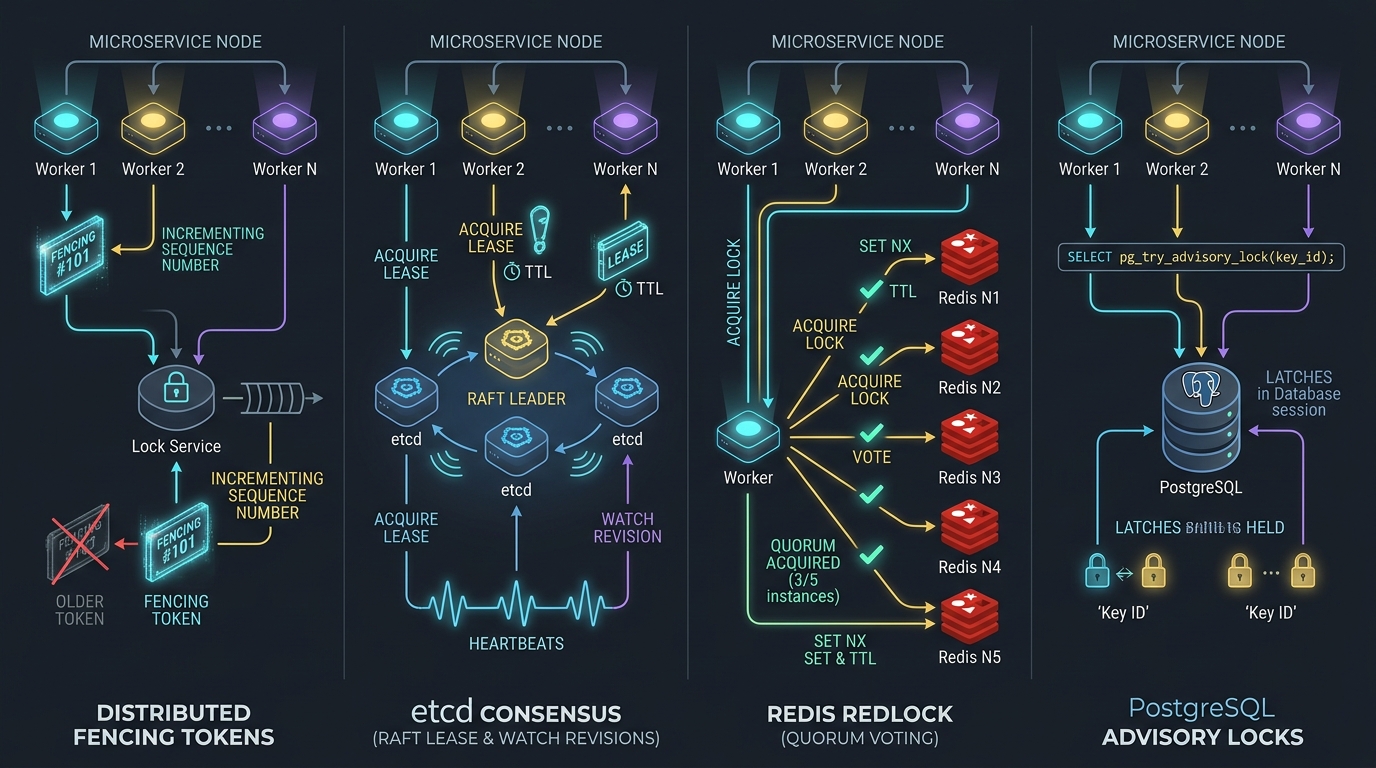
In a distributed cloud architecture with dozens of independently scaled worker instances, achieving mutual exclusion is an everyday necessity: ensuring only one worker executes a scheduled cron invoice run, preventing duplicate billing charges during concurrent checkout clicks, and serializing database migrations.
To coordinate these tasks, backend developers frequently reach for Distributed Locks. But building a distributed lock that is both safe against split-brain double executions and resilient against network partitions and node crashes is notoriously treacherous.
A naive implementation—such as executing SET resource_name my_random_token NX PX 30000 in Redis—seems deceptively simple. Yet under real-world conditions (garbage collection pauses, process thread freezes, NTP clock jumps, and asymmetric network delays), naive locks silently break, allowing multiple nodes to enter critical sections simultaneously and corrupting underlying business state.
In this systems engineering guide, we dissect the two primary purposes of distributed locks (Efficiency vs. Correctness), analyze the famous Martin Kleppmann vs. Salvatore Sanfilippo Redlock debate, master Fencing Tokens, compare etcd Raft Leases and PostgreSQL Advisory Locks, and construct a resilient distributed lock manager in Go.
The Two Purposes of Distributed Locking: Efficiency vs. Correctness
Before implementing a distributed lock, you must explicitly identify your system's failure tolerance:
| Locking Goal | Failure Consequence | Recommended Technology Stack |
|---|---|---|
| Efficiency (Optimization) | Minor waste of compute (e.g. two workers redundantly process the same image thumbnail or render an email template twice). No data corruption. | Single Redis instance / Redis Cluster with TTL (Fast, simple, low latency). |
| Correctness (Safety-Critical) | Catastrophic data corruption, double-charging a customer credit card, financial balance drift, split-brain cluster corruption. | Consensus-backed locks (etcd / Consul) with Fencing Tokens or PostgreSQL Advisory Locks. |
The GC Pause & Clock Skew Hazard: Why Naive Locks Fail
Why do standard TTL-based locks (like Redis SETNX with expiration) fail to guarantee correctness? Consider the Process Pause Hazard:
The Distributed Lock Process Pause Race Condition:

Client 1                              Lock Service (Redis)                  Shared Storage / Database
   │                                           │                                       │
   ├── 1. Acquire Lock (TTL: 10s) ────────────>│                                       │
   │<── 2. Lock Granted! ──────────────────────┤                                       │
   │                                           │                                       │
[ 3. Long Stop-the-World GC Pause (15s)! ]     │                                       │
[ Client 1 thread is FROZEN in memory ]        │                                       │
   │                                           │                                       │
   │                                   4. Lock TTL Expires!                            │
   │                                   (Redis deletes lock key)                        │
   │                                           │                                       │
   │                Client 2                   │                                       │
   │                   │                       │                                       │
   │                   ├── 5. Acquire Lock ───>│                                       │
   │                   │<── 6. Lock Granted! ──┤                                       │
   │                   │                       │                                       │
   │                   ├── 7. Writes Data to Database ────────────────────────────────>│ (Valid Write: V2)
   │                   │                       │                                       │
[ 8. Client 1 Wakes Up! ]                      │                                       │
[ Believes it STILL holds lock! ]              │                                       │
   │                                           │                                       │
   ├── 9. Overwrites Database Data! ──────────────────────────────────────────────────>│ (STALE WRITE CORRUPTS V2!)
   │                                           │                                       │
RESULT: MUTUAL EXCLUSION VIOLATED! Client 1 silently overrode Client 2's data!
No matter how long your TTL is, you cannot guarantee that a process will not experience an unexpected pause (Java/Go GC pause, OS thread preemption, page fault disk thrashing, or hypervisor CPU steal time) that exceeds the lease timeout.
The Architectural Cure: Monotonic Fencing Tokens
To safely prevent stale writes from suspended or partitioned workers, the lock service must issue an incrementing Fencing Token upon granting a lock:
Fencing Token Validation at the Storage Resource:

Client 1 acquires Lock ───> Lock Service returns: Fencing Token #101
Client 1 pauses (GC) ...
Lock expires!

Client 2 acquires Lock ───> Lock Service returns: Fencing Token #102
Client 2 writes to DB: [ Token: #102, Data: V2 ] ───> DB accepts & records max_token = 102!

Client 1 wakes up and attempts write: [ Token: #101, Data: V1 ]
Database checks: Is 101 >= max_token (102)? -> NO!
DATABASE REJECTS CLIENT 1's STALE WRITE! (Data safety preserved!)
The 3 Major Locking Paradigms Compared
| Locking Architecture | Underlying Engine | Safety & Operational Characteristics |
|---|---|---|
| Redis Redlock | 5 independent Redis nodes ($N=5$) | Acquires lock on $\lfloor N/2 \rfloor + 1$ nodes sequentially. Fast, but vulnerable to physical clock drift (NTP jumps) and requires complex client-side timeout math. |
| etcd / Consul Leases | Raft Consensus State Machine |
Strongest Safety: Linearizable Raft consensus, keep-alive heartbeat goroutines, and Watch notifications on lease revocation. Provides monotonic ModRevision as built-in fencing tokens.
|
| PostgreSQL Advisory Locks | Postgres Lock Manager (In-Memory) |
Zero Extra Infrastructure: Transaction-scoped (pg_advisory_xact_lock) or session-scoped. Automatically released upon transaction COMMIT/ROLLBACK or client TCP disconnect.
|
1. PostgreSQL Advisory Locks: Simple, Zero-Dependency Safety
If your application already uses PostgreSQL, you have a battle-tested distributed lock manager built directly into your database engine:
-- 1. Non-blocking try-lock using 64-bit integer key (Returns TRUE if acquired, FALSE if busy)
SELECT pg_try_advisory_lock(1048576);

-- 2. Transaction-level Advisory Lock (Automatically released at COMMIT / ROLLBACK)
BEGIN;
  -- Blocks until lock is acquired; guaranteed mutual exclusion during critical section!
  SELECT pg_advisory_xact_lock(1048576);

  -- Execute critical billing / invoice calculation safely...
  UPDATE accounts SET balance = balance - 100 WHERE id = 42;
COMMIT; -- Lock is ATOMICALLY released when transaction ends!
2. etcd Consensus Locks: The Gold Standard in Go
For high-throughput microservice clusters (e.g. Kubernetes controllers or distributed workers), etcd concurrency package provides linearizable leases with automatic background keep-alive heartbeats:
package main

import (
	"context"
	"fmt"
	"log"
	"time"

	clientv3 "go.etcd.io/etcd/client/v3"
	"go.etcd.io/etcd/client/v3/concurrency"
)

func main() {
	cli, err := clientv3.New(clientv3.Config{
		Endpoints:   []string{"localhost:2379"},
		DialTimeout: 5 * time.Second,
	})
	if err != nil {
		log.Fatalf("Failed to connect to etcd: %v", err)
	}
	defer cli.Close()

	// 1. Create concurrency session with a 10-second TTL
	// Session automatically starts a background goroutine to send keep-alive heartbeats!
	session, err := concurrency.NewSession(cli, concurrency.WithTTL(10))
	if err != nil {
		log.Fatalf("Failed to create etcd session: %v", err)
	}
	defer session.Close()

	// 2. Initialize distributed mutex on resource key
	mutex := concurrency.NewMutex(session, "/locks/monthly-payroll")
	ctx := context.Background()

	fmt.Println("Attempting to acquire distributed lock on /locks/monthly-payroll...")

	// 3. Acquire lock (Blocks until acquired or context cancelled)
	if err := mutex.Lock(ctx); err != nil {
		log.Fatalf("Failed to acquire lock: %v", err)
	}

	// 4. Extract monotonic fencing token (etcd Header Revision)
	fencingToken := mutex.Header().Revision
	fmt.Printf("[LOCK ACQUIRED] Fencing Token (Raft Revision): #%d\n", fencingToken)

	// Execute Critical Section...
	time.Sleep(3 * time.Second)

	// 5. Release Lock
	if err := mutex.Unlock(ctx); err != nil {
		log.Fatalf("Failed to unlock: %v", err)
	}
	fmt.Println("[LOCK RELEASED] Critical section completed cleanly.")
}
Summary & Engineering Decision Framework
- Need Efficiency Only? If an occasional double-execution causes no business harm (e.g. re-indexing a search document or sending an idempotent cache bust), a single Redis instance with TTL and random UUID verification is fast and adequate.
- Already on PostgreSQL? Leverage PostgreSQL Advisory Locks (
pg_advisory_xact_lock). They require zero extra infrastructure, operate with sub-millisecond in-memory speeds, and release automatically if the connection crashes. - Need Absolute Safety in Distributed Microservices? Use etcd or Consul Leases with background keep-alive heartbeats and enforce Monotonic Fencing Tokens at your storage layer to permanently protect against garbage collection pauses and network partitions.