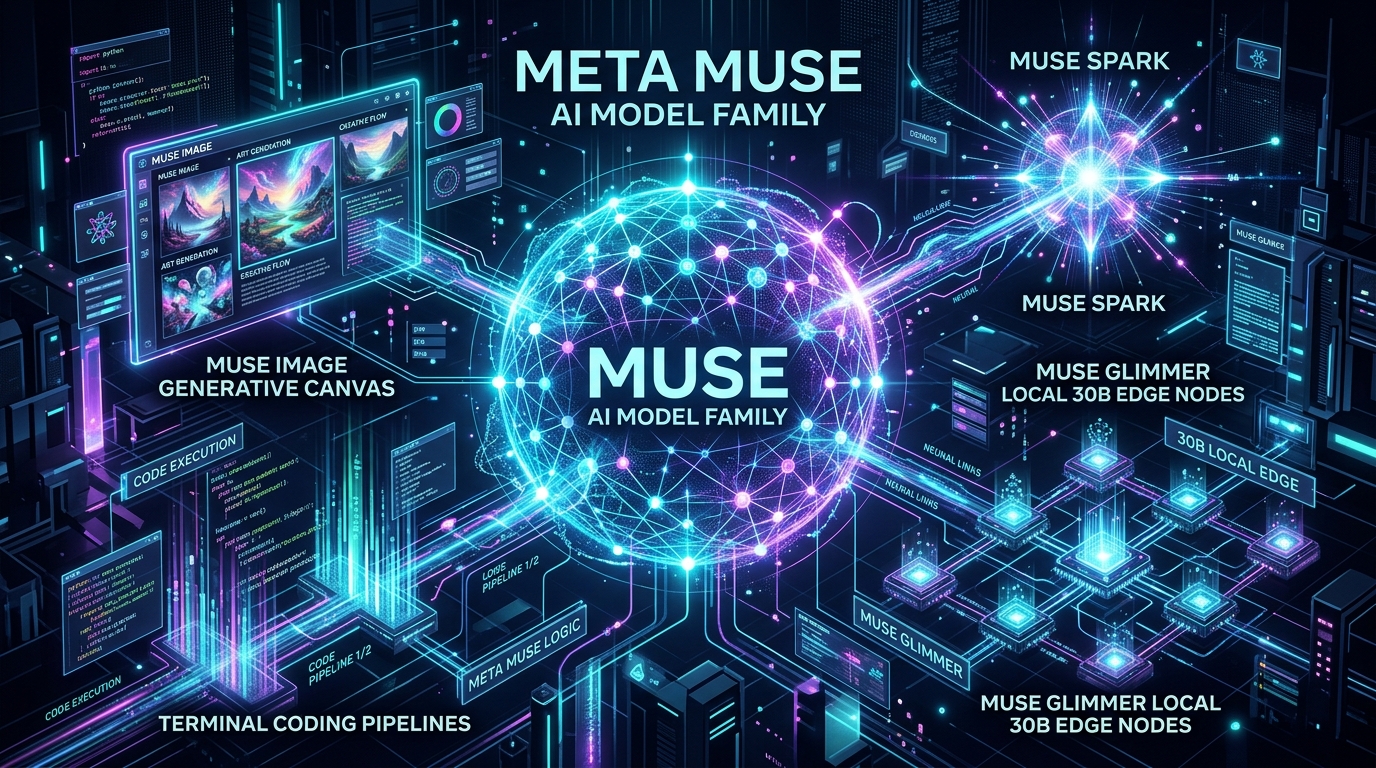
The artificial intelligence landscape is undergoing a monumental shift from static text prediction to dynamic, agentic reasoning systems capable of test-time thinking, autonomous tool orchestration, and local on-device execution. At the forefront of this evolution is the Muse AI ecosystem.
While the name "Muse" originally emerged in AI research as Google's 2023 masked generative transformer for fast text-to-image synthesis, the modern paradigm has expanded dramatically with the release of the Muse model family—a comprehensive suite of reasoning models (Muse Spark), open-weights local powerhouses (Muse Glimmer 30B), and reasoning-driven generative engines (Muse Image).
In this technical breakdown, we analyze how the Muse architecture works, why test-time reasoning outperforms brute-force parameter scaling, and how developers can self-host and build on top of this ecosystem.
The Pillars of the Modern Muse Family
Rather than shipping a single monolithic model, the modern Muse ecosystem is decoupled into specialized architectures designed for distinct operational workloads:
| Model Variant | Architecture & Scale | Primary Use Case | Deployment Tier |
|---|---|---|---|
| Muse Spark 1.3 | Multimodal Causal Transformer (1M Token Context) | Complex multi-step agentic workflows, repository-wide code refactoring, enterprise reasoning. | Cloud API / Enterprise |
| Muse Glimmer | 30 Billion Parameters (Distilled from Spark) | Local offline agentic task execution, privacy-compliant code assistance, edge inference. | Open Weights (Apache 2.0 / ~24GB VRAM) |
| Muse Image | Dual-layer Reasoning + Diffusion / Token Synthesis | Agentic image generation with pre-render visual planning, layout search, and multi-element consistency. | Meta AI & Model API |
| Muse Code | Autonomous Terminal Agent Layer | Sandbox OS command execution, automated testing, and git workspace management. | Developer CLI |
1. Muse Spark: 1-Million-Token Context & Test-Time Reasoning
The core innovation behind Muse Spark is its implementation of test-time reasoning. Traditional language models produce tokens sequentially based on historical probability distributions. In contrast, Muse Spark allocates dynamic computational compute before responding:
- Hypothesis Generation: Explores multiple reasoning branches to solve complex algorithmic problems.
- Autonomous Web & Tool Grounding: Formulates internal search queries to verify factual constraints before compiling code.
- Verification & Self-Correction: Detects logical contradictions or syntax errors in intermediate thoughts and backtracks automatically.
User Task: "Refactor legacy PHP 7.4 repository to Laravel 12 with strict types and tests"
       │
       ▼
[Muse Spark: Planning Phase]
   ├── Inspect 45 models & controllers
   ├── Identify deprecated methods
   └── Construct dependency graph
       │
       ▼
[Muse Spark: Test-Time Verification]
   ├── Draft refactored class
   ├── Simulate PHPStan Level 8 analysis
   └── Rectify type mismatch before outputting code
       │
       ▼
Final Verified Implementation Dispatched
2. Muse Glimmer 30B: True Open-Weights Local Intelligence
For engineering teams working with proprietary Intellectual Property, air-gapped systems, or sensitive financial data, cloud-only LLMs represent a major compliance bottleneck. Muse Glimmer (30B) bridges this divide by delivering near-frontier performance entirely on local developer hardware.
Hardware Requirements & Quantization:
- FP16 / BF16 (Unquantized): ~60 GB VRAM (Dual RTX 3090 / 4090 or single A6000).
- Q8_0 / Q6_K: ~28–34 GB VRAM (High accuracy, runnable on unified memory Mac M-series or 48GB workstation).
- Q4_K_M (4-bit quantization): ~18–22 GB VRAM (Runs seamlessly on a single consumer RTX 3090 / 4090 with 24GB VRAM).
Running Muse Glimmer via Ollama / vLLM
# Run locally using vLLM for high-throughput OpenAI-compatible API serving
vllm serve meta-muse/glimmer-30b-instruct \
    --quantization awq \
    --max-model-len 32768 \
    --gpu-memory-utilization 0.95 \
    --port 8000
3. Muse Image: Why "Agentic" Image Generation Outperforms Standard Diffusion
Standard text-to-image models (like Stable Diffusion or Midjourney) map prompts directly to noise latents. When presented with complex multi-character scenes, spatial directions, or legible typography, direct diffusion often suffers from prompt bleeding and spatial confusion.
Muse Image decouples generation into a two-stage agentic workflow:
- Reasoning Layer (Muse Spark): Parses user intent, plans the 2D bounding boxes, determines camera perspective, and searches reference concepts.
- Rendering Layer: Synthesizes pixels into the structured composition grid, resulting in flawless text rendering and anatomically consistent multi-object layouts.
Connecting via the Meta Model API
For cloud integrations, the Meta Model API provides a unified drop-in replacement that works with standard OpenAI SDKs:
<?php

use OpenAI;

$client = OpenAI::factory()
    ->withApiKey(env('META_MODEL_API_KEY'))
    ->withBaseUri('https://api.meta.ai/v1')
    ->make();

$response = $client->chat()->create([
    'model' => 'muse-spark-1.3',
    'messages' => [
        ['role' => 'system', 'content' => 'You are an expert system architect.'],
        ['role' => 'user', 'content' => 'Design a distributed rate-limiting middleware using Redis sliding windows.'],
    ],
    'temperature' => 0.2,
]);

echo $response->choices[0]->message->content;
Conclusion & Key Takeaways
- Dual-Track Strategy: Muse combines cloud-scale frontier reasoning (Muse Spark) with permissive open-source local models (Muse Glimmer 30B under Apache 2.0).
- Test-Time Compute: The future of AI performance relies on dynamic inference-time planning and verification rather than merely expanding training parameter count.
- Developer Accessibility: With drop-in OpenAI SDK compatibility and single-GPU 24GB VRAM quantizations, the Muse ecosystem offers developers flexible, enterprise-grade tooling for both cloud and local infrastructure.