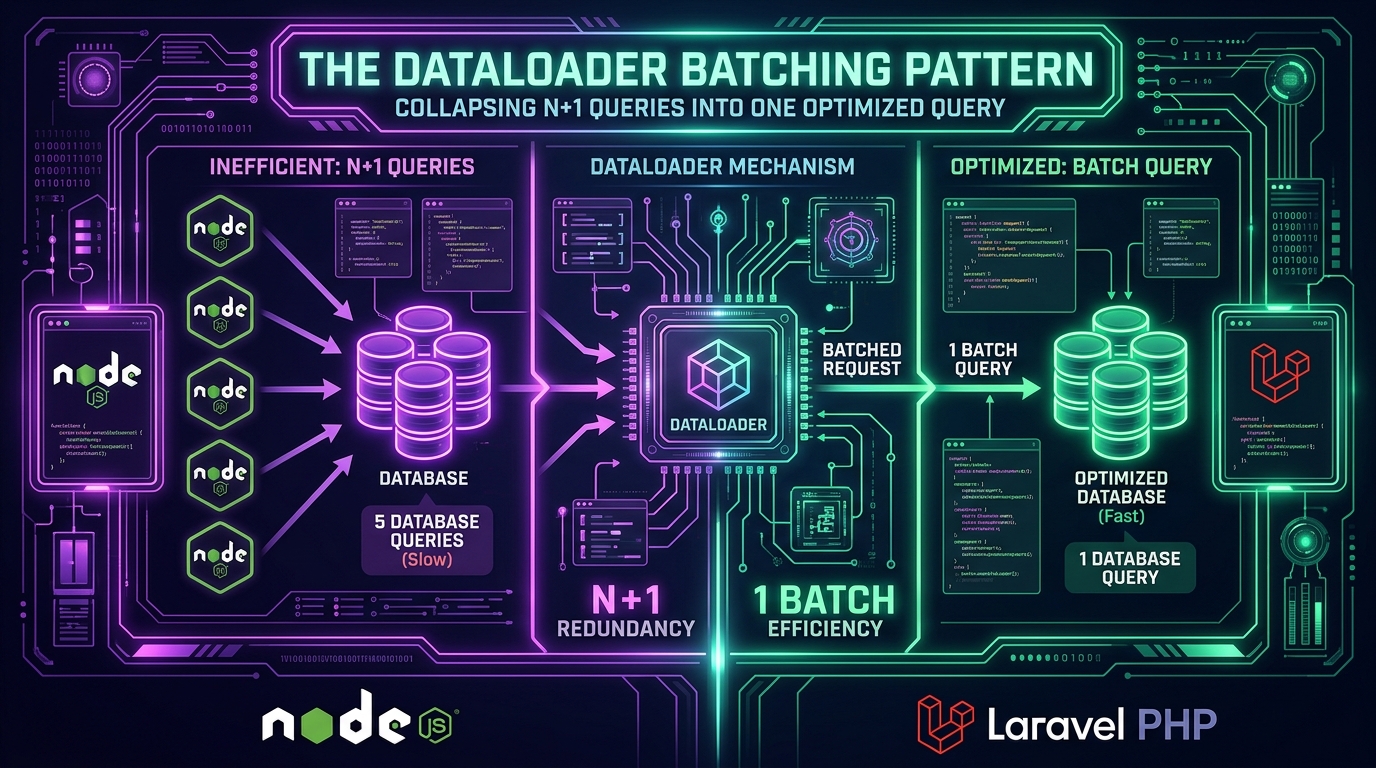
In modern web architectures, the N+1 query problem is one of the most pervasive performance bottlenecks. Whether building dynamic GraphQL APIs, recursive nested REST resources, or distributed microservice data aggregators, naive data fetching inevitably turns a single client request into dozens or hundreds of redundant round-trips to databases and downstream services.
Originally open-sourced by Facebook for JavaScript/Node.js, the DataLoader pattern is a utility pattern designed to solve this exact dilemma by decoupling individual data fetching requests from actual batch execution. It acts as an intelligent intermediary layer providing two core superpowers: Batching and Request-Scoped Memoization Caching.
In this architectural deep dive, we explore how DataLoader works under the hood, how Node.js leverages the Event Loop microtask queue for automatic batching, and how to implement a clean, robust, and Octane-safe DataLoader pattern in PHP and Laravel.
The Anatomy of the N+1 Problem
Consider a standard endpoint returning a list of 50 Blog Posts along with their corresponding Author profiles and Top Comments:
# Naive Execution Flow (51 Database Round-trips)
1. SELECT * FROM posts LIMIT 50;                  -- Query 1 (Fetch 50 posts)
2. SELECT * FROM users WHERE id = 1;              -- Query 2 (Post 1 Author)
3. SELECT * FROM users WHERE id = 2;              -- Query 3 (Post 2 Author)
...
51. SELECT * FROM users WHERE id = 12;            -- Query 51 (Post 50 Author)
In traditional monoliths with fixed schemas, ORM eager loading (e.g., Eloquent's Post::with('author')) works well. However, in GraphQL resolvers, JSON:API fieldsets, or microservices where components execute decoupled resolver functions independently, eager loading breaks down:
| Scenario | Eloquent / ORM with() |
DataLoader Pattern |
|---|---|---|
| Static Relational Endpoints | Excellent (Pre-declared JOIN/IN) | Excellent |
| Dynamic GraphQL Resolvers | Difficult (Requires complex AST parsing) | Native & Automatic |
| Remote Microservice HTTP Calls | Not supported by ORM | Fully Supported |
| Cross-Field Duplicate IDs | Fetches per relation | De-duplicates across entire request |
How DataLoader Works: The Two Core Pillars
DataLoader operates as an in-memory queue and memoized cache sitting between your application business logic and your data storage:
- Batching (Queue Coalescing): When your application calls
userLoader.load(1),userLoader.load(2), anduserLoader.load(1)across separate resolver functions within a single execution cycle, DataLoader queues the IDs. When the tick flushes, it executes a single batch function:fetchUsersByIds([1, 2]). - Memoization (Per-Request Cache): Calling
load(1)multiple times returns the exact same Promise/Value from memory, completely eliminating duplicate network queries within the same request lifecycle.
1. The Node.js Implementation: Event Loop Microtask Scheduling
In Node.js, DataLoader leverages the asynchronous Event Loop. When you call loader.load(id), DataLoader registers a Promise and schedules the batch dispatch function on process.nextTick() (or the Promise microtask queue).
All synchronous code within the current tick executes first, adding keys to the batch queue before the event loop drains the microtask queue and fires the batch query.
Production TypeScript Example
import DataLoader from 'dataloader';
import { db } from './database';

interface User {
  id: number;
  name: string;
  email: string;
}

// 1. Define the Batch Loading Function
// CRITICAL RULE: The returned array MUST match the input keys array in both LENGTH and ORDER.
async function batchUsers(keys: readonly number[]): Promise<(User | Error)[]> {
  // Execute a single SQL query: SELECT * FROM users WHERE id IN (...)
  const users = await db('users').whereIn('id', keys as number[]);

  // Map results by ID for O(1) lookup
  const userMap = new Map();
  users.forEach((user) => userMap.set(user.id, user));

  // Maintain strict 1:1 key-to-result order
  return keys.map((key) => userMap.get(key) ?? new Error(`User ${key} not found`));
}

// 2. Factory function creating per-request DataLoader instance
export function createUserDataLoader() {
  return new DataLoader(batchUsers, {
    cache: true,
    maxBatchSize: 200, // Prevent giant SQL IN(...) clauses
  });
}
Consuming the Loader in Resolvers
// Inside Post Resolvers (Executing across 50 posts concurrently)
export const postResolvers = {
  Post: {
    author: async (post, _args, context) => {
      // 50 individual calls automatically collapse into 1 batch SQL query!
      return context.loaders.userLoader.load(post.authorId);
    },
  },
};
2. The PHP & Laravel Paradigm: Building a Deferred DataLoader
PHP has historically operated under a synchronous, shared-nothing request execution lifecycle. There is no background event loop microtask queue by default unless using async runtimes like Laravel Octane (Swoole / RoadRunner) or deferred promise libraries.
To implement the DataLoader pattern in Laravel, we use a Deferred Batch Collector that queues requested IDs and resolves them lazily on demand or at serialization time.
Building a Reusable Laravel DataLoader
batchLoadCallback = $batchLoadCallback;
        $this->maxBatchSize = $maxBatchSize;
    }

    /**
     * Enqueue a key to be loaded.
     */
    public function load(int|string $key): self
    {
        if (!isset($this->cache[$key]) && !in_array($key, $this->keys, true)) {
            $this->keys[] = $key;
        }

        return $this;
    }

    /**
     * Dispatch queued batch lookups and populate in-memory cache.
     */
    public function dispatch(): void
    {
        if (empty($this->keys)) {
            return;
        }

        // Chunk large batches to respect database parameter limits
        $chunks = array_chunk($this->keys, $this->maxBatchSize);

        foreach ($chunks as $chunk) {
            $results = ($this->batchLoadCallback)($chunk);

            foreach ($results as $key => $value) {
                $this->cache[$key] = $value;
            }
        }

        $this->keys = [];
    }

    /**
     * Retrieve the resolved value from cache.
     */
    public function get(int|string $key): mixed
    {
        if (!array_key_exists($key, $this->cache)) {
            $this->load($key);
            $this->dispatch();
        }

        return $this->cache[$key] ?? null;
    }

    /**
     * Clear the cache (vital between requests in long-running workers like Octane).
     */
    public function clear(): void
    {
        $this->cache = [];
        $this->keys = [];
    }
}
Registering Scoped Loaders in Laravel
Bind the loader to Laravel's service container as a scoped service so that each incoming HTTP request gets a fresh instance that automatically cleans up after request completion:
app->scoped('userDataLoader', function () {
            return new DataLoader(function (array $ids) {
                return User::whereIn('id', $ids)
                    ->get()
                    ->keyBy('id')
                    ->all();
            });
        });
    }
}
Using DataLoader in API Resources / Controllers
 $this->id,
            'title' => $this->title,
            'author' => $userLoader->get($this->user_id),
        ];
    }
}
3. Batching Remote Microservices & Third-Party HTTP APIs
The DataLoader pattern shines brightly when aggregating data from downstream HTTP microservices. Without DataLoader, fetching 50 user profiles from a remote User Service creates 50 serial or concurrent HTTP connections, hammering downstream rate limits.
With DataLoader and Laravel's concurrent Http::pool(), remote batch endpoints consolidate these calls into a single network payload:
// Batch loading from an external microservice
$billingLoader = new DataLoader(function (array $customerIds) {
    $response = Http::baseUrl('https://billing-service.internal')
        ->timeout(3)
        ->post('/api/v1/customers/batch', [
            'customer_ids' => $customerIds,
        ]);

    return collect($response->json('data'))->keyBy('customer_id')->all();
});
The 4 Golden Rules of the DataLoader Pattern
| Rule | Requirement | Consequence of Violation |
|---|---|---|
| 1. Per-Request Lifetime | Instantiate a new DataLoader per HTTP request context | Critical memory leaks and cross-tenant data leakage in Node / Laravel Octane |
| 2. 1:1 Index Alignment (JS) | Returned array must match input keys array length and position | Promises resolve with incorrect data or silent corruption |
3. Set maxBatchSize |
Bound batch sizes (e.g. 200–500 keys) | Prevents hitting SQL parameter limits (e.g., SQLite 999 limit or Postgres memory ceilings) |
| 4. Granular Error Handling | Return Error instances per missing key instead of throwing globally |
Prevents a single missing record from failing the entire batch |
Summary
The DataLoader pattern transforms fragmented, N+1 query-heavy applications into streamlined, high-performance architectures. By combining event loop batching in Node.js or request-scoped deferred collectors in Laravel, you reduce database connection overhead, slash API response latencies, and cleanly decouple component resolvers from data access strategies.