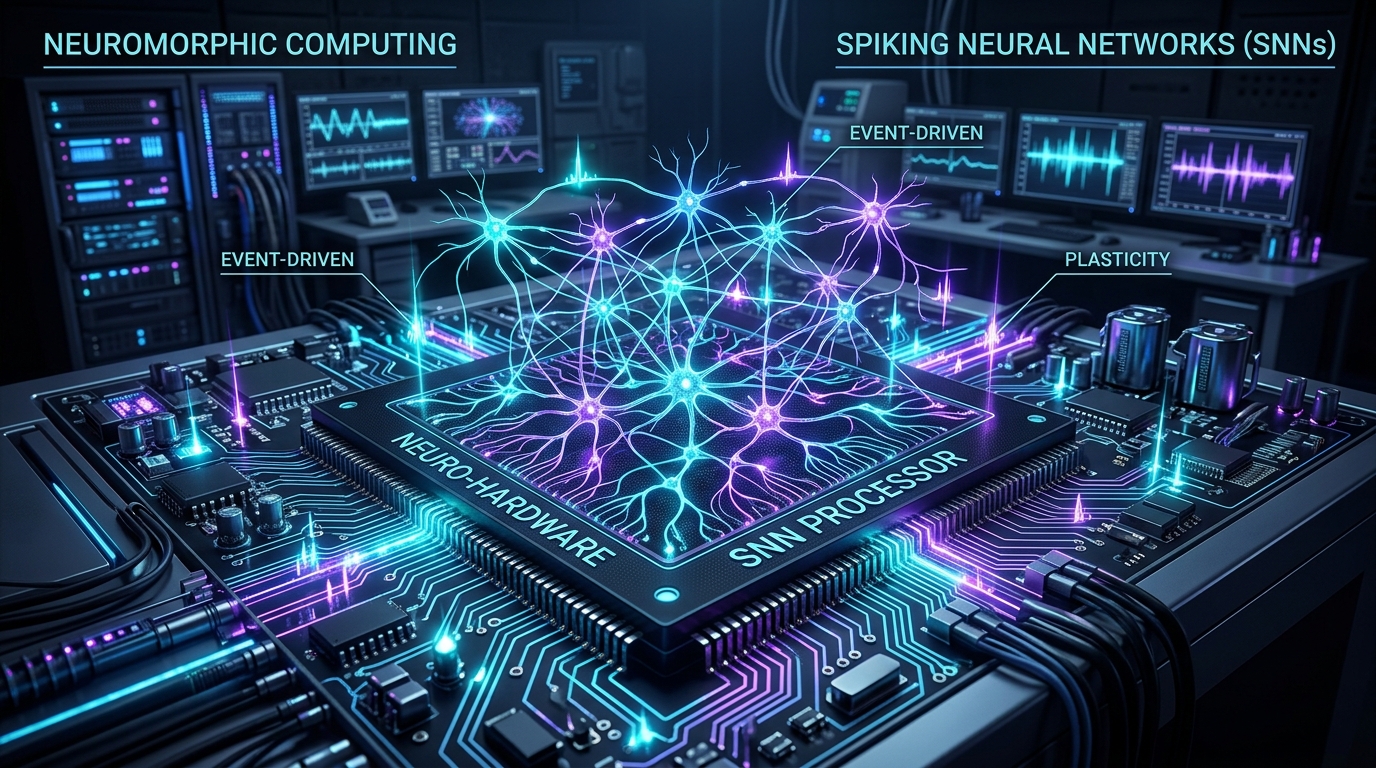
For over seventy years, the entire computing industry has been built on a single architectural foundation: the von Neumann architecture. In this classic paradigm, computation (the CPU/GPU) and memory (RAM/VRAM) exist as physically separated units connected by a shared data bus. Every single operation requires reading instructions and data from memory, executing the arithmetic, and writing the result back across the bus.
In the modern era of deep learning and multi-billion-parameter neural networks, this separation has hit a physical wall known as the von Neumann Memory Bottleneck. GPUs burn megawatts of electrical power simply shuttling 32-bit floating-point weights across memory buses, executing dense matrix multiplications on every clocked cycle even when input sensory streams are completely stationary.
Meanwhile, the human biological brain processes complex multimodal vision, speech, and motor control concurrently while consuming a mere 20 Watts of power. The brain achieves this staggering efficiency because it does not operate like a von Neumann computer: it is asynchronous, highly distributed, co-locates memory with processing, and communicates strictly through sparse temporal electrical spikes.
Neuromorphic Computing and Spiking Neural Networks (SNNs) translate these biological principles directly into silicon hardware. In this architectural guide, we break down why standard neural networks are energy-inefficient, explore the mathematical mechanics of Leaky Integrate-and-Fire neurons, compare neuromorphic hardware platforms (like Intel Loihi 2), and examine how event-driven computing is reshaping the AI infrastructure landscape.
The von Neumann Bottleneck vs. The Neuromorphic Paradigm
| Architectural Dimension | Classical Architecture (CPU / GPU / TPU) | Neuromorphic Architecture (Intel Loihi / Akida) |
|---|---|---|
| Memory & Compute Topology | Separated (RAM ↔ Bus ↔ ALUs) | Co-located (Synaptic memory fused inside each neuron core) |
| Execution Model | Synchronous clock-driven cycles | Asynchronous event-driven (Executes only when spikes arrive) |
| Data Representation | Dense floating-point matrices (FP16 / FP32 / INT8) | Sparse binary spikes (0 or 1 pulses over time) |
| Idle Power Consumption | High baseline power (Continuous clock gating) | Near-Zero ($P \approx 0$ when no sensory events occur) |
| Energy Efficiency Scale | Tens of Watts to Kilowatts per cluster | Milliwatts to Micro-Joules per inference |
How Spiking Neural Networks (SNNs) Work Under the Hood
In standard Artificial Neural Networks (ANNs like Transformers or CNNs), artificial neurons pass continuous scalar values through continuous non-linear activation functions ($y = \text{ReLU}(Wx + b)$). Every layer computes activations for all neurons regardless of whether the input changed.
In contrast, Spiking Neural Networks (SNNs) encode information in the precise timing of discrete electrical pulses (spikes):
+-------------------------------------------------------------------------+
|                  LEAKY INTEGRATE-AND-FIRE (LIF) NEURON                  |
|                                                                         |
|   Incoming Spikes            Membrane Potential V(t)        Output Spike|
|                                                                         |
|   t_1: ---|------> [ +w_1 ] ---\                                        |
|   t_2: -----|----> [ +w_2 ] ----+-> ( Accumulate & Leak ) --> [ V > V_th? ]
|   t_3: -------|--> [ +w_3 ] ---/       V(t) = V(t-1)*decay            |
|                                                 |                     v
|                                                 +-----> [ EMIT SPIKE & RESET ]
+-------------------------------------------------------------------------+
The Mathematics of the Leaky Integrate-and-Fire (LIF) Neuron
The state of a spiking neuron is governed by its membrane potential $V(t)$, which evolves over discrete time steps $t$ according to a differential decay equation:
                     dV(t)     -(V(t) - V_rest)
                     ----- =  ------------------ + I_synaptic(t)
                      dt             tau_m
- Integration: When incoming spikes arrive across connected synapses, the weights $w_i$ are added to the neuron's membrane potential $V(t)$.
- Leak: In the absence of incoming spikes, $V(t)$ exponentially decays back down to its resting potential $V_{\text{rest}}$ controlled by time constant $\tau_m$.
- Fire & Reset: If $V(t)$ surpasses the firing threshold $V_{\text{th}}$, the neuron fires a single binary output spike ($S=1$) downstream and immediately resets its membrane potential back to $V_{\text{reset}}$.
Hands-On: Simulating a Spiking Neuron in Python with snnTorch
Here is how a Leaky Integrate-and-Fire (LIF) spiking neuron is constructed and simulated over temporal time steps using Python:
# spiking_neuron_simulation.py
import torch
import snntorch as snn
from snntorch import spikegen

# 1. Initialize Leaky Integrate-and-Fire Neuron
# beta: membrane potential decay rate (0.8 = 20% leak per step)
# threshold: voltage threshold required to fire a spike
lif_neuron = snn.Leaky(beta=0.8, threshold=1.0, reset_mechanism="subtract")

# 2. Generate a random input current over 50 time-steps
num_steps = 50
input_current = torch.rand(num_steps) * 1.5

# Initialize membrane potential state
mem_voltage = torch.zeros(1)
spike_record = []
voltage_record = []

print("Simulating event-driven biological neuron over 50 temporal steps...")

# 3. Simulate temporal execution loop
for step in range(num_steps):
    current = input_current[step]

    # Compute next state: outputs binary spike (0 or 1) and new membrane voltage
    spike, mem_voltage = lif_neuron(current, mem_voltage)

    spike_record.append(spike.item())
    voltage_record.append(mem_voltage.item())

total_spikes = sum(spike_record)
print(f"Simulation Complete: Neuron emitted {int(total_spikes)} discrete spikes across {num_steps} steps.")
Major Neuromorphic Silicon Platforms
| Platform | Manufacturer | Silicon Architecture | Target Application Domain |
|---|---|---|---|
| Loihi 2 | Intel Labs | 1 Million micro-code programmable neurons, Intel 4 process, asynchronous Network-on-Chip (NoC). | Robotics, real-time combinatorial graph optimization, adaptive sensory learning. |
| Akida NPU | BrainChip | Commercial event-based neural processor IP core. | Edge IoT, automotive auditory anomaly detection, sub-milliwatt computer vision. |
| Xylo Audio | SynSense | Ultra-low-power asynchronous digital SNN audio core. | Always-on wake-word detection consuming < 100 μW of power. |
Real-World Breakthroughs: Where Neuromorphic Dominates
- Dynamic Neuromorphic Vision (Event Cameras / DVS):
Standard cameras capture 60 full frames per second, wasting bandwidth re-recording static backgrounds. Event-based Dynamic Vision Sensors (DVS) mimic the biological retina: each individual pixel independently emits a spike only when its luminance changes. When paired with neuromorphic chips, drones can track high-speed obstacles in microsecond reaction windows without processing bloated frame buffers.
- Ultra-Low-Power Edge Acoustic Monitoring:
Industrial machinery monitoring (detecting bearing wear, turbine vibration shifts, or acoustic leaks) traditionally requires streaming audio to cloud servers. Neuromorphic NPUs run on-chip continuous acoustic classification on a coin-cell battery for up to 5 years.
- Real-Time Combinatorial Optimization:
Problems like the Traveling Salesperson Problem (TSP), train scheduling, and packet routing can be mapped onto recurring spiking attractor networks on Intel Loihi 2, finding mathematically optimal solutions orders of magnitude faster than classical branch-and-bound algorithms.
Summary
As the AI industry confronts thermal and electrical power boundaries, Neuromorphic Computing provides the definitive blueprint for sustainable intelligence. By replacing the continuous matrix multiplication of von Neumann architectures with sparse, event-driven temporal spikes, neuromorphic silicon unlocks orders-of-magnitude gains in energy efficiency, low-latency reaction times, and edge autonomy.