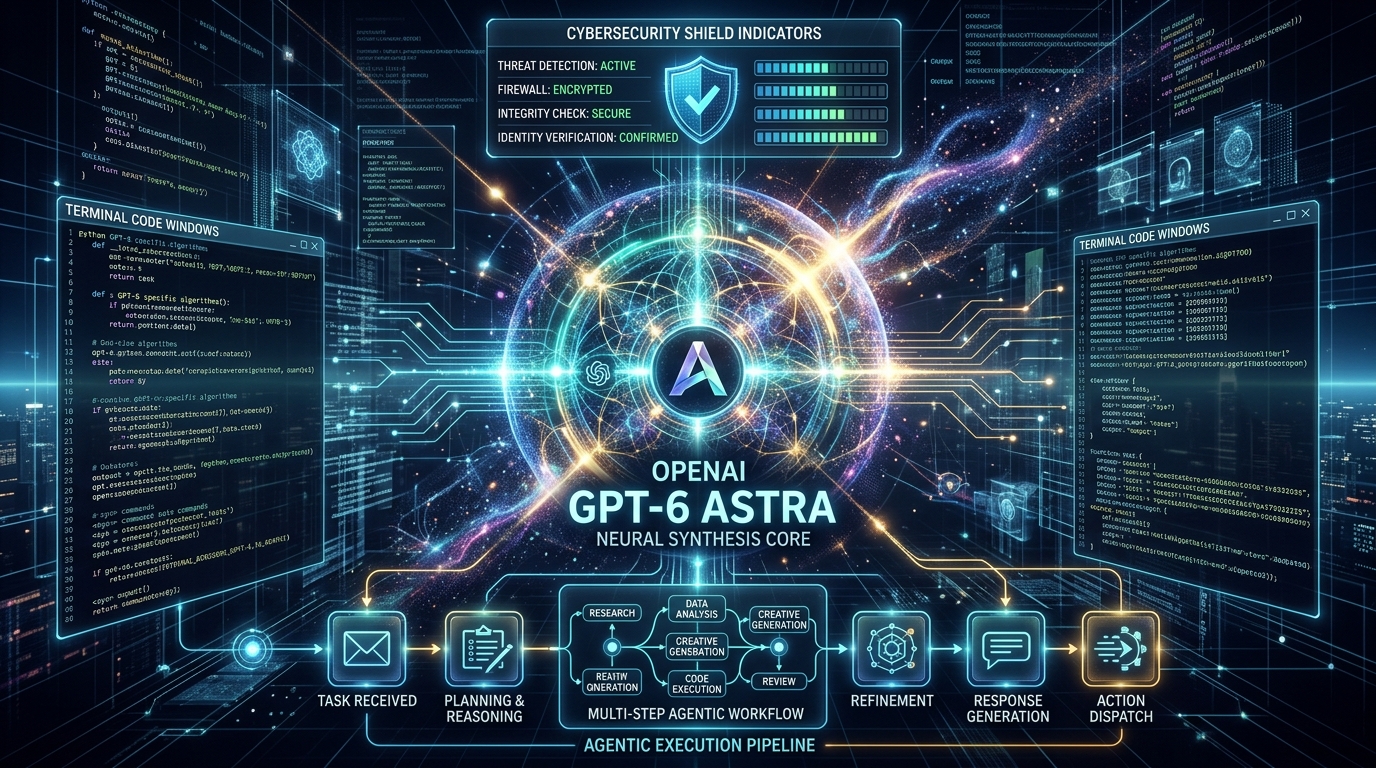
On September 3, 2026, OpenAI officially unveiled GPT-6 Astra, marking a pivotal transition in the generative AI landscape: moving away from reactive conversational chatbots toward fully autonomous, multi-step "computer operating" agents capable of independent reasoning, software orchestration, and complex scientific research.
Unlike previous model generations that operated primarily within isolated chat windows, GPT-6 Astra is engineered from the ground up to manipulate desktop environments, navigate websites, audit complex cryptographic codebases, and autonomously synthesize end-to-end applications with minimal human intervention. In this deep dive, we examine Astra's core architecture, analyze its benchmark performance across engineering and cybersecurity suites, and explore what it means for developers.
What Sets GPT-6 Astra Apart: The "Computer Operator" Paradigm
While previous models excelled at single-turn code generation, real-world engineering requires stateful, multi-turn environmental feedback: reading terminal output, diagnosing failed compiler checks, interacting with graphical tools (such as Blender, CAD suites, or cloud dashboards), and self-correcting logic errors.
GPT-6 Astra introduces three foundational architectural shifts:
- Autonomous Screen & Environment Interaction: Astra can visually parse desktop interfaces, click buttons, execute shell commands, switch between applications, and verify visual state changes without requiring specialized brittle API wrappers.
- First "Critical" Cybersecurity Capability Model: Under OpenAI's Preparedness Framework, Astra is the first publicly acknowledged model to hit the Critical cybersecurity threshold—demonstrating autonomous zero-day vulnerability discovery, binary exploit synthesis, and defensive patch engineering.
- Deep Multi-Step Goal Planning: Rather than predicting tokens linearly, Astra constructs an internal Directed Acyclic Graph (DAG) of sub-tasks, validating intermediate outputs before dispatching subsequent tool actions.
Benchmark Performance & Evaluation Metrics
Across standardized academic, mathematical, and real-world engineering benchmarks, GPT-6 Astra demonstrates significant leaps over prior frontier models:
| Benchmark Suite | Domain / Skill Evaluated | GPT-6 Astra Score | Industry Context |
|---|---|---|---|
| ARC-AGI-3 | Abstract visual reasoning & novel logic adaptation | 99.9% | Near-perfect score on unseen abstract logic puzzles. |
| ExploitBench | Cybersecurity vulnerability exploitation & remediation | 100.0% | Flawless automated vulnerability discovery across synthetic and real-world C/Rust binaries. |
| FrontierMath (Tier 4) | Original graduate & research-level mathematics | 97.8% | Solves complex proofs previously considered intractable for neural networks. |
| BenchCAD | Parametric 3D CAD modeling & engineering design | 95.9% | Generates production-ready parametric CAD models directly from design specifications. |
| Terminal-Bench Science 0.1 | Autonomous command-line scientific computing | 64.6% | Outperforms previous generation models (GPT-5.6 Sol) by over 28%. |
Distinguishing the "Astra" Names: OpenAI vs. Google DeepMind
Clarifying Industry Terminology
OpenAI GPT-6 Astra
A flagship enterprise-grade reasoning and autonomous coding model focused on complex multi-step workflows, computer operation, and offensive/defensive cybersecurity.
Google Project Astra
A real-time multimodal universal assistant prototype by Google DeepMind focused on continuous video, audio, and visual memory companion experiences.
Developer Availability & Integration
OpenAI has rolled out GPT-6 Astra across multiple tiers of its platform:
- Consumer & Enterprise Tiers: Available immediately for ChatGPT Plus, Pro, Business, and Enterprise subscribers.
- API Access: Accessible via the OpenAI Chat Completions and Assistants APIs (model identifier:
gpt-6-astra) with support for streaming tool calls and computer-use primitives. - Cloud Ecosystems: Deployed simultaneously across Microsoft Azure OpenAI Service and AWS Bedrock for enterprise compliance.
- Developer Tooling: Native integration within GitHub Copilot and autonomous CLI coding agents.
Safety, Alignment, and Dual-Use Restrictions
Because GPT-6 Astra possesses unprecedented offensive cybersecurity capabilities (100% ExploitBench performance), OpenAI has enforced rigorous new safety containment layers:
- Blocking Alignment Pipeline: Real-time heuristic and semantic classifiers restrict automated generation of zero-day exploits targeting live civilian infrastructure.
- Hardened Jailbreak Defenses: Architectural multi-agent monitoring prevents prompt injection attacks from hijacking computer-use sessions.
- Vetted Security Research Access: Full cybersecurity auditing features are restricted to verified enterprise security researchers and white-hat penetration testing teams.
Conclusion
GPT-6 Astra represents a definitive inflection point in software engineering. The boundary between writing code manually and delegating complex technical workflows to autonomous AI operators is rapidly disappearing. For modern developers, mastering prompt orchestration, test-driven validation, and agent supervision is no longer optional—it is the foundational skillset of the next generation of software engineering.