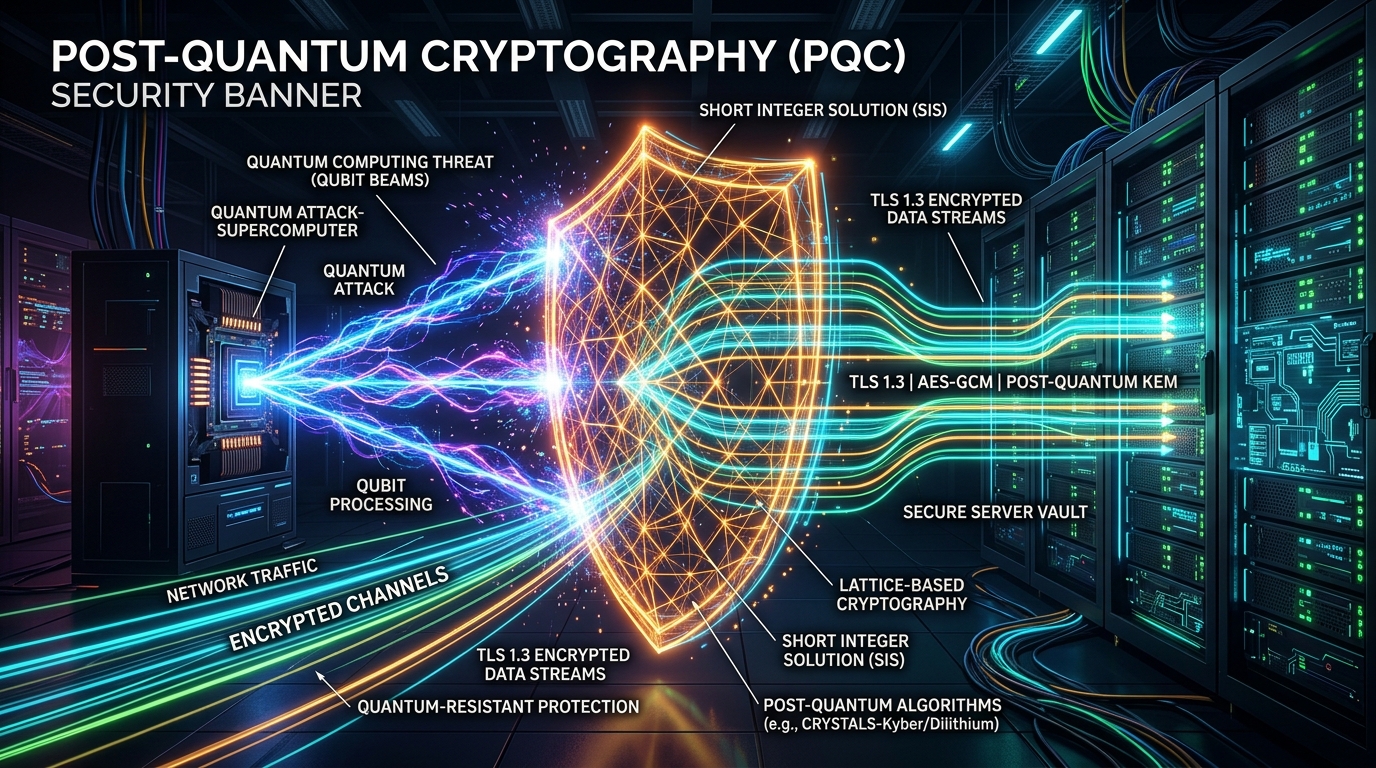
For nearly four decades, modern internet security has rested on a shared mathematical foundation: the computational difficulty of prime integer factorization (RSA) and the discrete logarithm problem over elliptic curves (ECDH / ECDSA). Today, every HTTPS request, SSH session, database connection pool, and JWT auth token relies on these asymmetric algorithms.
When fault-tolerant quantum computers arrive, Shor's Algorithm will solve these mathematical problems in polynomial time, rendering all classical public-key cryptography completely obsolete in a matter of seconds.
While a cryptographically relevant quantum computer (CRQC) is still years away, backend systems face an immediate threat today: "Harvest Now, Decrypt Later" (HNDL) attacks, where adversaries intercept and store encrypted internet traffic today to decrypt it retrospectively in the future. Any data with a confidentiality lifespan exceeding 5 to 10 years (financial ledgers, medical records, proprietary algorithms, master database credentials) is already exposed.
In this guide, we break down the newly finalized NIST Post-Quantum Cryptography (PQC) standards (FIPS 203 & 204), explore how lattice-based encryption works, analyze network MTU trade-offs, and demonstrate how to deploy Hybrid TLS 1.3 in modern backend stacks.
The Quantum Threat Matrix: What Breaks vs. What Survives
A common misconception is that quantum computers break all encryption. In reality, asymmetric public-key systems and symmetric block ciphers are impacted very differently:
| Cryptographic Algorithm | Primary Use Case | Quantum Impact | Remediation Strategy |
|---|---|---|---|
| RSA (2048 / 4096-bit) | Key Exchange & Digital Signatures | ❌ Completely Broken (Shor's Algorithm) | Replace with ML-KEM / ML-DSA |
| ECDH / ECDSA (Curve25519, P-256) | TLS Handshakes & API Signatures | ❌ Completely Broken (Shor's Algorithm) | Replace with ML-KEM / ML-DSA |
| AES-256 (GCM / CBC) | Symmetric Data at Rest | ✅ Quantum Resistant (Grover's reduces to 128-bit) | Keep using AES-256; deprecate AES-128 |
| SHA-256 / SHA-3 / BLAKE3 | Cryptographic Hash Functions | ✅ Quantum Resistant | No immediate migration needed |
The Finalized NIST Standards: Lattice-Based Cryptography
Instead of prime numbers, modern PQC algorithms rely on Lattice-Based Cryptography (specifically the Module Learning With Errors problem). In simple terms, finding shortest vector points in high-dimensional (512+ dimensional) mathematical grids is exponentially hard for both classical computers and quantum computers:
+-------------------------------------------------------------------------+
|                    NIST POST-QUANTUM STANDARDS                          |
|                                                                         |
|  +-----------------------------------+  +----------------------------+  |
|  |     FIPS 203: ML-KEM (Kyber)      |  |  FIPS 204: ML-DSA (Dilith) |  |
|  |   Module-Lattice Key Exchange     |  |   Module-Lattice Signature |  |
|  +-----------------------------------+  +----------------------------+  |
|                  |                                     |                |
|                  v                                     v                |
|       TLS 1.3 Key Handshake                  API / Token Signature      |
|  (Establishes shared AES session)       (JWT auth, PKI certificates)   |
+-------------------------------------------------------------------------+
- FIPS 203: ML-KEM (formerly CRYSTALS-Kyber): A Key Encapsulation Mechanism (KEM) used to establish a shared symmetric secret over untrusted networks.
- FIPS 204: ML-DSA (formerly CRYSTALS-Dilithium): A digital signature scheme used for identity verification and certificate authorities.
- FIPS 205: SLH-DSA (formerly SPHINCS+): A stateless hash-based signature scheme serving as a non-lattice fallback.
The Engineering Trade-Off: Public Key & Network MTU Inflation
Lattice encryption is extremely fast computationally (often outperforming RSA in CPU cycles), but it introduces a major physical penalty: massive key and ciphertext sizes:
| Algorithm | Public Key Size | Ciphertext / Signature Size | TCP MTU Impact (1500 Bytes) |
|---|---|---|---|
| Classical X25519 | 32 bytes | 32 bytes | Fits cleanly in 1 TCP packet |
| Classical RSA-2048 | 256 bytes | 256 bytes | Fits in 1 TCP packet |
| ML-KEM-768 (PQC) | 1,184 bytes | 1,088 bytes | May span across 2 TCP segments |
| ML-DSA-65 (Signature) | 1,952 bytes | 3,309 bytes | Requires multi-packet fragmentation |
Network Tuning Tip: Because ML-KEM ClientHello frames exceed standard 1500-byte Ethernet MTUs, ensure your Linux server's
tcp_init_cwnd(initial congestion window) is set to at least 10 (default in modern Linux kernels) to avoid extra round-trip time (RTT) penalties during TLS negotiation.
The Hybrid Strategy: X25519MLKEM768
Because post-quantum algorithms are relatively new, the global cryptographic community (IETF, Google, Cloudflare) recommends Hybrid Key Exchange. Instead of choosing between classical or quantum, the TLS handshake performs both simultaneously:
ClientHello -> [ Classical X25519 Key (32B) + ML-KEM-768 Key (1184B) ]
ServerHello -> [ Classical Shared Secret + ML-KEM Shared Secret ]
Shared Key  -> HKDF-Extract(X25519_Secret || MLKEM_Secret)
If ML-KEM turns out to have an undiscovered algebraic vulnerability, classical X25519 protects the connection. If a quantum computer breaks X25519, ML-KEM preserves security.
Hands-On Configuration: Enabling Hybrid PQC in Production
1. Enabling Hybrid PQC in Go (1.23+)
Starting with Go 1.23, hybrid post-quantum key exchange (X25519MLKEM768) is supported natively in standard library TLS:
// main.go - Quantum-Resistant HTTP Client in Go
package main

import (
	"crypto/tls"
	"fmt"
	"net/http"
	"time"
)

func main() {
	// Configure TLS client with X25519MLKEM768
	tlsConfig := &tls.Config{
		MinVersion: tls.VersionTLS13,
		CurvePreferences: []tls.CurveID{
			tls.X25519MLKEM768, // Post-Quantum Hybrid
			tls.X25519,
		},
	}

	transport := &http.Transport{
		TLSClientConfig: tlsConfig,
		ForceAttemptHTTP2: true,
	}

	client := &http.Client{
		Transport: transport,
		Timeout:   10 * time.Second,
	}

	resp, err := client.Get("https://sejan.dev")
	if err != nil {
		panic(err)
	}
	defer resp.Body.Close()

	fmt.Printf("Connected using TLS 1.3 PQC Hybrid! Status: %d\n", resp.StatusCode)
}
2. Enabling Hybrid PQC in Rust (with rustls / aws-lc-rs)
// Cargo.toml: rustls = { version = "0.23", default-features = false, features = ["aws_lc_rs"] }
use rustls::crypto::aws_lc_rs::default_provider;

pub fn build_quantum_safe_client() -> rustls::ClientConfig {
    let mut config = rustls::ClientConfig::builder_with_provider(default_provider().into())
        .with_safe_default_protocol_versions()
        .unwrap()
        .with_root_certificates(rustls::RootCertStore::empty())
        .with_no_client_auth();

    // AWS-LC-RS automatically includes X25519MLKEM768 in default key exchange groups
    config
}
The 4-Step Enterprise PQC Migration Roadmap
| Phase | Action Item | Priority Level |
|---|---|---|
| Phase 1: Cryptographic Inventory | Audit all endpoints, database fields, internal gRPC services, and certificates using RSA/ECC. | Immediate (Q1–Q2) |
| Phase 2: Edge Hybrid TLS | Enable X25519MLKEM768 on CDNs, load balancers, and reverse proxies (protects data in transit against HNDL). |
Immediate |
| Phase 3: Symmetric Key Hardening | Enforce AES-256 (or ChaCha20-Poly1305) for all database column encryption and backups. | Low Effort / High Value |
| Phase 4: PKI & Signature Migration | Transition internal Certificate Authorities, OAuth JWT signing, and SSH keys to ML-DSA. | Medium Term (2026–2028) |
Summary
Post-Quantum Cryptography is no longer a distant theoretical concern—it is an active infrastructure requirement. By adopting Hybrid TLS 1.3 key exchange (X25519MLKEM768) today, upgrading symmetric stores to AES-256, and planning your internal PKI transition to ML-DSA, you insulate your backend systems against current "Harvest Now, Decrypt Later" interceptors and future quantum breakthroughs.