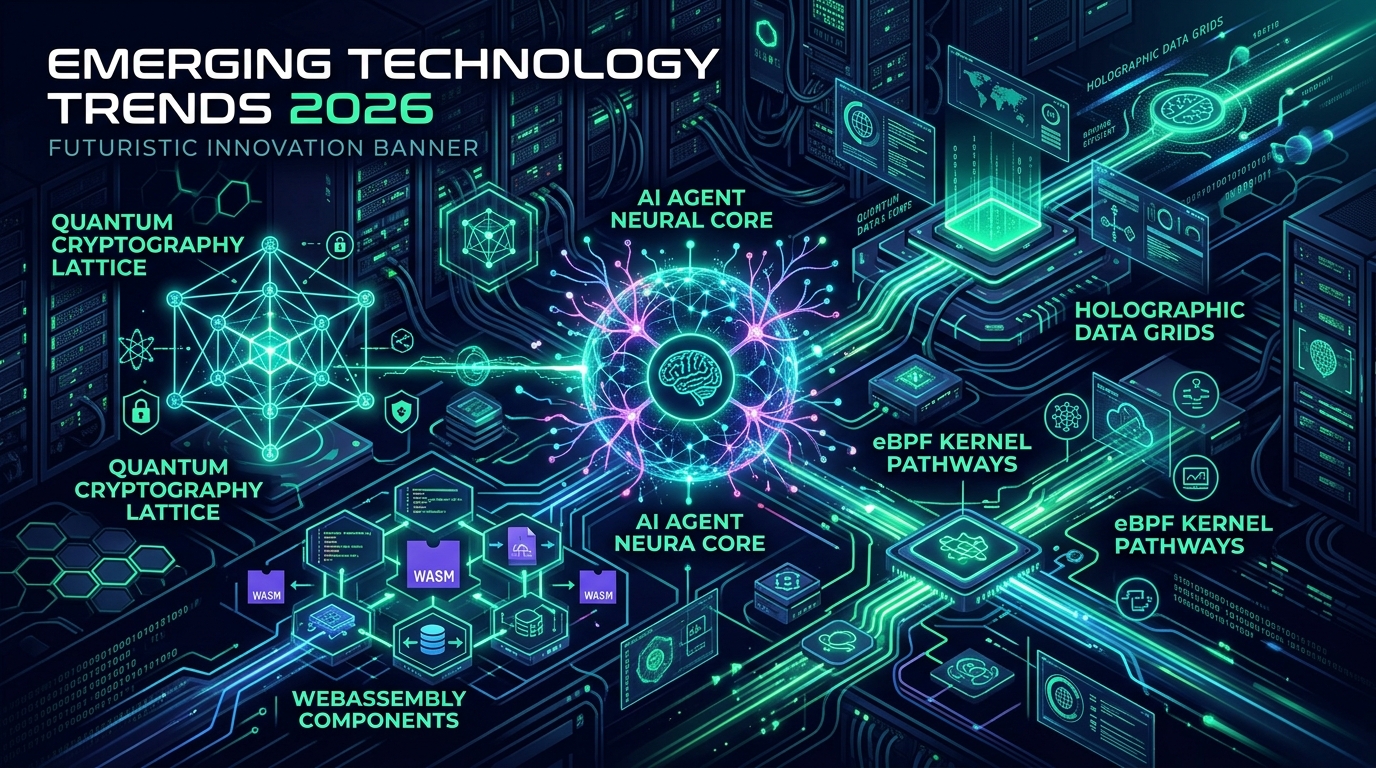
The software engineering landscape is evolving at a breakneck velocity. Concepts that were theoretical academic papers or niche experimental prototypes only two years ago—such as lattice-based post-quantum encryption, WebAssembly component runtimes, and agentic tool protocols—are rapidly becoming standard requirements in production system design.
Whether you are designing distributed cloud systems, architecting backend APIs, or building AI-native developer tooling, mastering modern terminology and architectural paradigms is critical to making future-proof engineering decisions.
In this comprehensive guide, we dissect the top 10 emerging technology trends and architectural terms shaping the software industry in 2026, breaking down what problem each solves, how it works under the hood, and how it impacts modern engineering stacks.
1. Agentic Runtimes & MCP (Model Context Protocol)
The industry has decisively moved beyond basic "chat with an LLM" interfaces toward Agentic Runtimes. An agentic runtime is the operating system and state machine surrounding a foundation model that enables multi-turn autonomous goal execution (the ReAct loop: Reason + Act).
At the center of this transition is MCP (Model Context Protocol), an open, standardized client-server protocol that acts like the "USB-C of AI." Instead of building proprietary API wrappers for every database, filesystem, or tool, an application exposes standard MCP endpoints that any AI agent can securely discover and invoke:
| Legacy Paradigm | Agentic + MCP Paradigm |
|---|---|
| Hardcoded bespoke tool wrappers in Python/JS scripts | Standardized JSON-RPC protocol over stdio / SSE |
| Single-turn prompt/completion responses | Autonomous multi-step execution with safety gates |
2. Post-Quantum Cryptography (PQC: ML-KEM & ML-DSA)
With quantum computers inching closer to breaking traditional public-key algorithms (RSA, Diffie-Hellman, Elliptic Curve) via Shor's Algorithm, security teams are mitigating the threat of "Harvest Now, Decrypt Later" (HNDL) attacks—where adversaries capture encrypted network traffic today to decrypt it once quantum hardware matures.
NIST has officially finalized its first post-quantum standards:
- FIPS 203 (ML-KEM / Kyber): Lattice-based key encapsulation for establishing secure TLS connections.
- FIPS 204 (ML-DSA / Dilithium): Lattice-based digital signatures for verifying software binaries, certificates, and identities.
Major cloud providers and CDNs have already enabled hybrid Post-Quantum TLS (e.g., X25519MLKEM768), combining classical elliptic curves with lattice keys to ensure zero downtime during the cryptographic transition.
3. Edge WebAssembly & The WASI 0.2 Component Model
Docker revolutionized containerization, but container pods carrying full Linux guest OS layers are too heavy for low-latency serverless edge computing (often suffering from 300ms–2,000ms cold starts). Enter WebAssembly (Wasm) paired with WASI 0.2 (WebAssembly System Interface).
WASI 0.2 introduces the Component Model: composable, language-agnostic binary modules that execute within secure micro-sandboxes with sub-millisecond cold starts (under 0.5ms) and near-zero memory overhead. You can write business logic in Rust, compile it to a .wasm component, and link it seamlessly with a Go HTTP router at the edge.
4. Speculative Decoding & Multi-Token Drafters
Generating text from massive 70B+ parameter LLMs is fundamentally memory-bandwidth bound. In standard auto-regressive generation, the model reads billions of weights from VRAM to generate a single token, leaving GPU compute cores largely idle.
Speculative Decoding solves this by pairing the primary large model with a lightweight, lightning-fast "draft model" (or multi-head speculative architecture like Medusa):
- The tiny draft model speculatively generates 5 candidate tokens in parallel (taking negligible time).
- The large foundation model verifies all 5 candidate tokens in a single forward pass.
- Tokens that pass verification are accepted immediately, doubling or tripling token generation speed without altering output quality.
5. GraphRAG (Knowledge-Graph-Augmented Retrieval)
First-generation Retrieval-Augmented Generation (RAG) relied solely on flat vector embeddings and cosine similarity. While effective for simple question-answering, vector search struggles with multi-hop questions like: "How did the security changes introduced in Q1 affect the authentication module in Q3?"
GraphRAG combines vector similarity with structured Knowledge Graphs (KGs). Text chunks are processed into entity-relationship nodes (e.g., Service A -> depends_on -> Database B). When an agent receives a query, it traverses relational graph edges and hierarchical community clusters, delivering dramatically higher contextual precision and eliminating hallucinations in complex codebases.
6. eBPF (Extended Berkeley Packet Filter) Observability
Historically, instrumenting production systems for distributed tracing, metrics, and security required invasive code changes (e.g., injecting APM SDKs into application code or deploying heavy sidecar proxies). eBPF allows developers to run sandboxed, high-performance programs directly inside the Linux kernel without modifying the kernel source or loading unsafe kernel modules.
Tools powered by eBPF (such as Cilium, Pixie, and Falco) monitor network packets, system calls, and file I/O with near-zero CPU overhead, providing instant zero-instrumentation telemetry across Kubernetes clusters.
7. Confidential Computing & Hardware Enclaves (TEEs)
Modern data security traditionally focused on two states: Data at Rest (encrypted on disk with AES-256) and Data in Transit (encrypted over the wire with TLS 1.3). However, Data in Use (data actively held in RAM while executing CPU instructions) remained vulnerable to compromised hypervisors, cloud operators, or rogue root processes.
Confidential Computing uses hardware-enforced Trusted Execution Environments (TEEs)—such as AMD SEV-SNP, Intel TDX, and AWS Nitro Enclaves—to encrypt RAM memory in hardware. Even if an attacker gains root access to the physical host server, the memory contents remain completely inaccessible.
8. Neuromorphic Silicon & Event-Driven SNNs
As standard von Neumann computer architectures hit physical power and thermal limits (the "power wall"), Neuromorphic Computing mimics the biological architecture of the human brain. Instead of constantly calculating matrix multiplications across clocked cycles, neuromorphic chips (like Intel Loihi and BrainChip Akida) use Spiking Neural Networks (SNNs).
Neurons in neuromorphic hardware only fire when an event occurs ("event-driven processing"), reducing operational power consumption by up to 1,000x (milliwatts instead of tens of watts), making them ideal for always-on robotics, IoT sensors, and edge AI.
9. Green Software Engineering & Carbon-Aware Workload Scheduling
With data centers consuming an increasing percentage of global electrical grids, cloud architects are adopting Green Software Engineering principles. Key metrics include the Software Carbon Intensity (SCI) score, which quantifies the carbon emitted per functional unit (e.g., per 1,000 API requests).
Carbon-Aware Scheduling dynamically shifts non-urgent background batch workloads (e.g., ML model training, video transcoding, database vacuuming) across global cloud regions or schedules them during hours when local electrical grids have surplus renewable wind and solar power.
10. Zero-Knowledge Proofs (ZKPs & zk-SNARKs for Data Privacy)
While originally popularized by cryptographic blockchains and rollups, Zero-Knowledge Proofs (ZKPs) have entered mainstream enterprise architecture. A ZKP allows one party (the prover) to cryptographically prove to another party (the verifier) that a statement is true without revealing any underlying data.
| Enterprise Use Case | How Zero-Knowledge Proofs Work |
|---|---|
| Age / Identity Verification | Prove a user is over 21 without revealing their date of birth, name, or SSN. |
| Regulatory Financial Compliance | Prove a bank has sufficient capital reserves without exposing private balance sheets. |
| Private AI Computation | Prove an AI model was executed on medical data without leaking the model weights or patient records. |
Architecture Quick Reference Summary
| Technology Trend | Core Advantage | Key Standard / Tool |
|---|---|---|
| Agentic Runtimes (MCP) | Standardized tool protocol for AI agents | Model Context Protocol (MCP) |
| Post-Quantum Crypto (PQC) | Immunity to quantum Shor algorithms | ML-KEM (FIPS 203) / ML-DSA (FIPS 204) |
| Edge Wasm (WASI 0.2) | <0.5ms cold-start micro-sandboxes | Wasm Component Model |
| Speculative Decoding | 2x–3x LLM inference speedup | Medusa / Draft Verification |
| GraphRAG | Multi-hop relational context for LLMs | Knowledge Graphs + Vector Hybrid |
| eBPF Observability | Zero-overhead kernel distributed tracing | Cilium / Pixie / Falco |
Keeping pace with these architectural shifts ensures your engineering teams build systems that are resilient, scalable, quantum-secure, and ready for the next decade of computing.