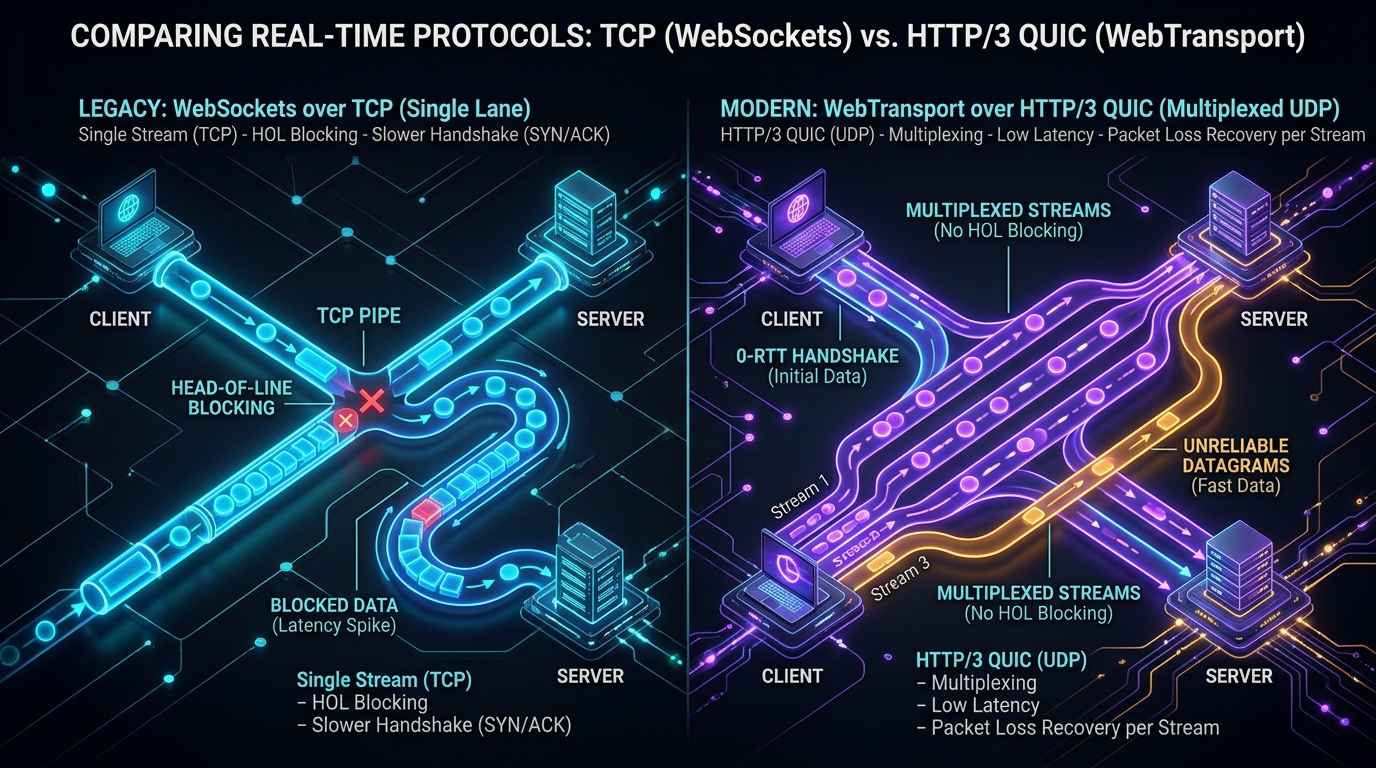
Since 2011, the WebSocket protocol (RFC 6455) has been the undisputed standard for real-time bidirectional communication on the web. From live chat applications and financial dashboards to collaborative document editors and multiplayer games, WebSockets replaced clumsy HTTP long-polling with persistent, full-duplex TCP socket connections.
Yet, as modern web applications demand sub-50ms latency, continuous 4K video/audio ingestion, and high-frequency IoT/gaming telemetry, the architectural foundation of WebSockets—TCP—has become its greatest limitation. Over mobile and congested wireless networks, a single lost TCP packet triggers Head-of-Line (HOL) Blocking, freezing all multiplexed application traffic across the entire connection.
To eliminate this bottleneck, the IETF and W3C introduced WebTransport. Built natively on top of HTTP/3 and QUIC (UDP), WebTransport provides multiplexed bidirectional streams, unidirectional streams, and out-of-order unreliable datagrams within a single encrypted connection with zero Head-of-Line blocking and 0-RTT handshakes.
In this architectural guide, we dissect the internal mechanics of WebTransport vs. WebSockets and WebRTC DataChannels, analyze QUIC stream multiplexing and connection migration, and build a production-ready WebTransport server in Go and client in TypeScript.
The Achilles' Heel of WebSockets: TCP Head-of-Line (HOL) Blocking
To understand why WebSockets struggle under real-world network conditions, we must inspect how TCP enforces reliability:
TCP Head-of-Line Blocking in WebSockets:

Client Application sends 3 messages:
[ Msg 1: Chat Text ]   [ Msg 2: Cursor Position (Ephemeral) ]   [ Msg 3: Document Edit ]
         │                               │                                 │
         └───────────────────────────────┼─────────────────────────────────┘
                                         ▼
                               [ Single TCP Stream ]
                [ Packet 1 ] ────> [ Packet 2 (DROPPED ON WIRE!) ] ────> [ Packet 3 ]
                                         │
                                         ▼
                            [ Receiver OS TCP Buffer ]
                    Packet 1: Received & Delivered to Application
                    Packet 2: LOST -> TCP sends ACK requesting retransmission!
                    Packet 3: BUFFERED IN OS KERNEL & BLOCKED!
                    (Application CANNOT read Packet 3 until Packet 2 is retransmitted!)
                    RESULT: Entire application freezes for 100ms - 500ms!
Because TCP guarantees a strict byte-stream order, the operating system kernel will never deliver subsequent packets to the application until the missing packet is retransmitted and acknowledged. Even if Message 2 was an ephemeral mouse coordinate that no longer matters, Message 3 (critical business logic) is blocked.
Enter HTTP/3 & QUIC: The UDP Revolution
QUIC (RFC 9000) moves transport-layer semantics from kernel-space TCP into user-space over UDP, integrating TLS 1.3 encryption natively into the transport handshake:
| QUIC / HTTP/3 Feature | How It Works | Real-World Advantage |
|---|---|---|
| Independent Stream Multiplexing | QUIC manages thousands of concurrent logical streams. Each stream has its own independent sequence and flow control. | Zero HOL Blocking: Packet loss on Stream A only delays Stream A; Streams B, C, and D continue flowing at full line rate! |
| 0-RTT Handshakes | Combines cryptographic TLS 1.3 keys and transport negotiation in the very first network flight. | Sub-10ms Session Resumption: Returning clients transmit application data immediately without waiting for a 3-way handshake. |
| Connection Migration | Connections are identified by a 64-bit Connection ID (CID) rather than the (IP, Port) 4-tuple. | Seamless Mobile Handover: When a user walks out of Wi-Fi onto 5G Cellular, the connection survives without reconnecting or re-authenticating! |
WebTransport Communication Primitives
While WebSockets only offer a single bidirectional stream, WebTransport exposes three distinct communication primitives over a single QUIC session:
The 3 WebTransport Communication Primitives:

┌────────────────────────────────────────────────────────────────────────┐
│                        WEBTRANSPORT SESSION (QUIC)                     │
│                                                                        │
│  1. Unreliable Datagrams (UDP semantics)                               │
│     [ Fast, Unordered, Droppable ] ─────────> Gaming / Video Frames    │
│                                                                        │
│  2. Unidirectional Streams (Fire-and-forget ordered streams)           │
│     [ Client -> Server ONLY ] ──────────────> Metrics / Telemetry Logs │
│                                                                        │
│  3. Bidirectional Streams (Independent TCP-like full-duplex streams)  │
│     [ Client <====> Server ] ───────────────> Chat / Transactions / RPC│
└────────────────────────────────────────────────────────────────────────┘- Unreliable Datagrams: Transmit small messages ($< 1200\text{ bytes}$) with minimal latency overhead. If a packet drops, it is never retransmitted. Ideal for game player coordinates, sensor telemetry, and live voice/video samples.
- Unidirectional Streams: Independent, reliable, ordered byte streams flowing in a single direction. Ideal for logging analytics, transmitting chunked files, or streaming LLM AI tokens.
- Bidirectional Streams: Independent, reliable full-duplex streams. If one stream stalls, other streams are completely unaffected. Ideal for transactional requests, RPC invocations, and state synchronization.
Architectural Comparison: WebSockets vs. WebRTC vs. WebTransport
| Feature / Metric | WebSockets (RFC 6455) | WebRTC DataChannels | WebTransport (HTTP/3) |
|---|---|---|---|
| Underlying Transport | TCP + TLS | UDP + DTLS + SCTP | UDP + QUIC + HTTP/3 |
| Head-of-Line Blocking | Severe (Single TCP stream) | None (Configurable per channel) | None (Per-stream isolation) |
| Unreliable Datagrams | No (Reliable only) | Yes (Unordered SCTP) | Yes (Native QUIC Datagrams) |
| Connection Setup Latency | 2–3 RTT (TCP + TLS + Upgrade) | Complex (ICE, STUN, TURN, SDP) | 1 RTT (0-RTT on resumption) |
| Proxy & Firewall Friendly | Universal (Port 80/443) | Poor (Requires TURN relays) | Excellent (Standard HTTP/3 Port 443) |
Hands-On Implementation: Building a WebTransport Server in Go
Below is a production-grade WebTransport server built using the official quic-go/webtransport-go library in Go:
package main

import (
	"context"
	"fmt"
	"io"
	"log"
	"net/http"

	"github.com/quic-go/quic-go/http3"
	"github.com/quic-go/webtransport-go"
)

func main() {
	// Configure WebTransport Server
	server := webtransport.Server{
		H3: http3.Server{
			Addr: ":4433",
		},
		CheckOrigin: func(r *http.Request) bool {
			return true // Allow all origins for development
		},
	}

	http.HandleFunc("/wt", func(w http.ResponseWriter, r *http.Request) {
		session, err := server.Upgrade(w, r)
		if err != nil {
			log.Printf("Upgrade failed: %v", err)
			w.WriteHeader(http.StatusInternalServerError)
			return
		}

		log.Printf("New WebTransport Session established: %s", session.RemoteAddr())

		// Handle Incoming Unreliable Datagrams in background goroutine
		go func() {
			for {
				msg, err := session.ReceiveDatagram(context.Background())
				if err != nil {
					return
				}
				fmt.Printf("[Datagram Received] %s\n", string(msg))
				// Echo datagram back with low latency!
				session.SendDatagram([]byte("ECHO: " + string(msg)))
			}
		}()

		// Handle Incoming Bidirectional Streams
		go func() {
			for {
				stream, err := session.AcceptStream(context.Background())
				if err != nil {
					return
				}
				go handleBidirectionalStream(stream)
			}
		}()
	})

	log.Println("WebTransport Server running on https://localhost:4433/wt")
	log.Fatal(server.ListenAndServeTLS("server.crt", "server.key"))
}

func handleBidirectionalStream(stream webtransport.Stream) {
	defer stream.Close()
	buf := make([]byte, 4096)
	for {
		n, err := stream.Read(buf)
		if err != nil {
			if err != io.EOF {
				log.Printf("Stream read error: %v", err)
			}
			return
		}
		// Echo stream payload back to client
		stream.Write([]byte(fmt.Sprintf("STREAM_REPLY: %s", string(buf[:n]))))
	}
}
Client-Side TypeScript: Consuming WebTransport in the Browser
Modern Chromium, Firefox, and Safari browsers provide the native WebTransport global object:
async function connectWebTransport() {
  const url = 'https://localhost:4433/wt';
  const transport = new WebTransport(url);

  // Wait for connection to establish
  await transport.ready;
  console.log('WebTransport session connected successfully!');

  // 1. Sending and Receiving Unreliable Datagrams (e.g. Player Movement)
  const datagramWriter = transport.datagrams.writable.getWriter();
  const datagramReader = transport.datagrams.readable.getReader();

  // Send datagram
  const encoder = new TextEncoder();
  await datagramWriter.write(encoder.encode(JSON.stringify({ x: 120.5, y: 340.2, timestamp: Date.now() })));

  // Listen for datagrams
  (async () => {
    while (true) {
      const { value, done } = await datagramReader.read();
      if (done) break;
      const text = new TextDecoder().decode(value);
      console.log('Received Datagram:', text);
    }
  })();

  // 2. Sending a Dedicated Bidirectional Stream (e.g. Chat or Order Submission)
  const stream = await transport.createBidirectionalStream();
  const streamWriter = stream.writable.getWriter();
  const streamReader = stream.readable.getReader();

  await streamWriter.write(encoder.encode('ORDER_CREATE: sku_94821'));

  const { value: response } = await streamReader.read();
  console.log('Stream Response:', new TextDecoder().decode(response));
}

connectWebTransport().catch(console.error);
Summary & Architecture Roadmap
- Retire WebSockets for Latency-Critical Workloads: If your application suffers from packet-loss stalls over cellular networks or streams independent channels (e.g. live video + audio + comments), migrate to WebTransport to eliminate Head-of-Line blocking.
- Mix Streams and Datagrams Intelligently: Use Unreliable Datagrams for high-frequency ephemeral updates (cursor positions, physics ticks) and Bidirectional Streams for transactional mutations (orders, chat messages).
- Plan for Fallback: While HTTP/3 QUIC adoption is widespread, enterprise corporate firewalls occasionally block UDP port 443. Always maintain a graceful fallback negotiation to standard WebSockets or SSE.