In conventional backend systems and distributed APIs, proving a statement almost always requires surrendering the raw underlying data. To prove a user is over 21, the application must ingest their full government birthdate. To verify creditworthiness, a bank must inspect an unencrypted credit score. To verify regulatory compliance, a financial institution must expose its complete transaction ledger.
This paradigm creates massive honeypots of centralized sensitive data, exposing organizations to catastrophic data leaks, regulatory fines, and cross-service privacy violations.
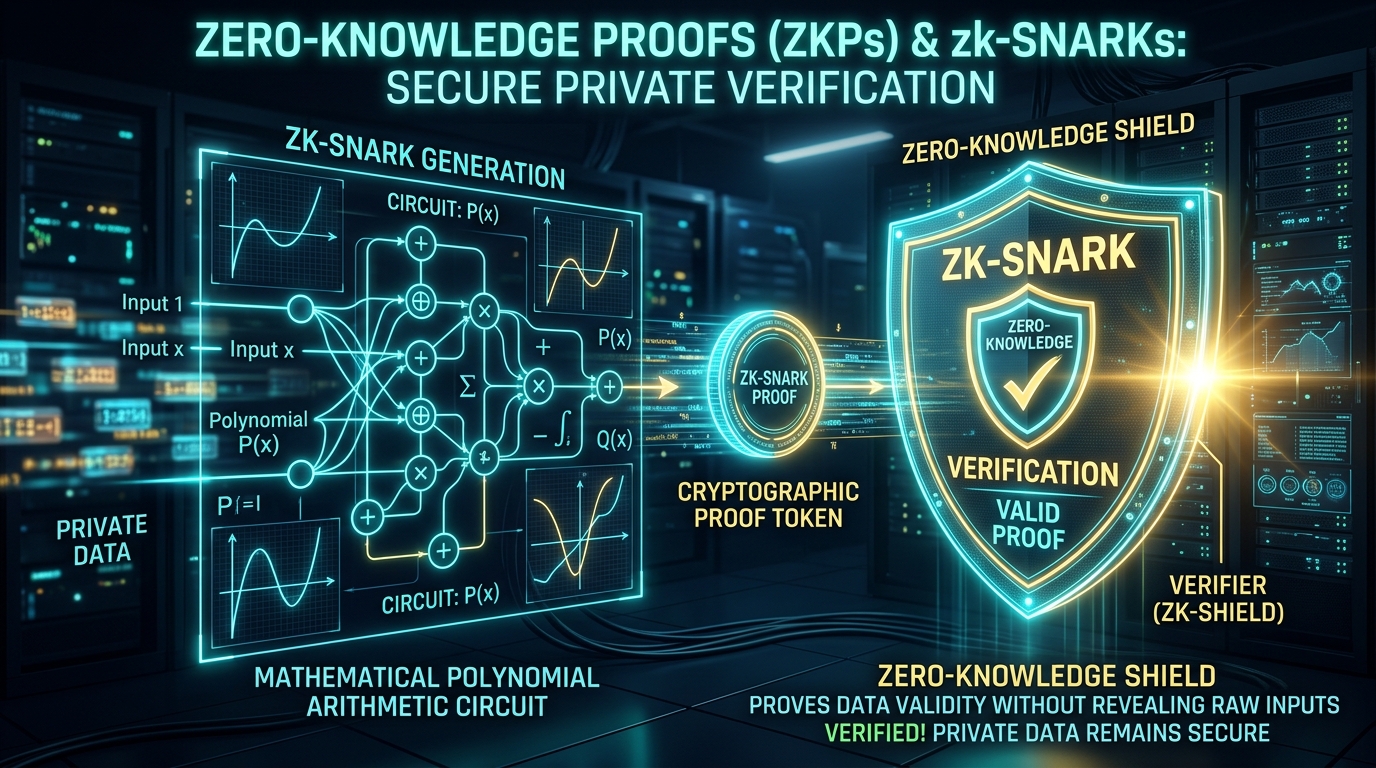
Zero-Knowledge Proofs (ZKPs)—specifically non-interactive zero-knowledge arguments of knowledge (zk-SNARKs and zk-STARKs)—break this compromise. A ZKP allows a prover to mathematically prove to a verifier that a computational statement is 100% valid without revealing a single bit of the underlying private inputs (the "witness").
In this engineering guide, we demystify how Zero-Knowledge Proofs work under the hood, compare zk-SNARK algorithms (Groth16, PLONK, STARKs), examine arithmetic circuits, and build a working zero-knowledge verification pipeline in Circom and TypeScript.
The 3 Mathematical Pillars of Zero-Knowledge Proofs
For any cryptographic protocol to qualify as a valid Zero-Knowledge Proof, it must satisfy three formal mathematical properties:
| Property | Mathematical Guarantee | Engineering Implication |
|---|---|---|
| 1. Completeness | If the statement is true and both parties are honest, the verifier will always be convinced. | Valid transactions and proofs are never rejected. |
| 2. Soundness | If the statement is false, a cheating prover cannot convince the verifier (probability of successful forgery is cryptographically negligible, e.g. $2^{-128}$). | No attacker can forge a valid proof without actually knowing the valid private inputs. |
| 3. Zero-Knowledge | The verifier learns nothing other than the fact that the statement is true. | The private witness is never leaked, logged, or exposed in RAM or over network sockets. |
How zk-SNARKs Work: The Arithmetic Circuit Pipeline
How does arbitrary code (like if (age >= 18)) transform into a cryptographic proof? The computation goes through a four-stage compilation pipeline:
+-------------------------------------------------------------------------+
|                        ZK-SNARK COMPILATION PIPELINE                    |
|                                                                         |
|  1. High-Level Logic (Circom / Rust / Noir)                             |
|     - e.g. "age >= 18 AND credit_score >= 700"                          |
|                                                                         |
|  2. Arithmetic Circuit                                                  |
|     - Decomposed into addition (+) and multiplication (*) gates         |
|       over a finite field F_p                                           |
|                                                                         |
|  3. Rank-1 Constraint System (R1CS)                                     |
|     - System of matrix vectors satisfying: (A . s) * (B . s) = (C . s)  |
|                                                                         |
|  4. Quadratic Arithmetic Program (QAP) & Polynomial Commitments         |
|     - Interpolates constraints into high-degree polynomials             |
|     - Evaluated via Elliptic Curve Pairings (KZG / IPA)                 |
|                                                                         |
|  OUTPUT: Compact Cryptographic Proof (e.g. ~200 Bytes in Groth16)        |
+-------------------------------------------------------------------------+
Comparing Major ZK Proving Systems: Groth16 vs. PLONK vs. STARKs
| Proving System | Proof Size | Verification Time | Trusted Setup Required? | Quantum Resistant? |
|---|---|---|---|---|
| Groth16 | ~130 – 200 Bytes (Tiny) | < 2 ms (Fastest) | Yes (Circuit-specific ceremony) | No (Elliptic curve pairings) |
| PLONK / Boojum | ~400 – 800 Bytes | < 5 ms | Universal (Run once for all circuits) | No (KZG commitments) |
| zk-STARKs | 40 KB – 100 KB (Larger) | 10 – 50 ms | None (Zero trusted setup) | Yes (Hash-based FRI) |
Hands-On: Building a Private Eligibility Circuit in Circom
Let's write a simple Circom circuit that proves a user meets age and minimum account balance requirements without disclosing their actual birthdate or bank balance:
// eligibility.circom
pragma circom 2.1.6;

include "circomlib/circuits/comparators.circom";

template FinancialEligibility() {
    // Private Inputs (The secret witness - never revealed to the verifier)
    signal input userAge;
    signal input userBalance;

    // Public Inputs (Known to both prover and verifier)
    signal input minAge;
    signal input minBalance;

    // Output Signal (1 = Eligible, 0 = Ineligible)
    signal output isEligible;

    // 1. Verify userAge >= minAge
    component ageCheck = GreaterEqThan(8);
    ageCheck.in[0] <== userAge;
    ageCheck.in[1] <== minAge;

    // 2. Verify userBalance >= minBalance
    component balanceCheck = GreaterEqThan(32);
    balanceCheck.in[0] <== userBalance;
    balanceCheck.in[1] <== minBalance;

    // 3. Both conditions must hold
    isEligible <== ageCheck.out * balanceCheck.out;
    isEligible === 1; // Enforce constraint: circuit only solves if eligible
}

component main {public [minAge, minBalance]} = FinancialEligibility();
Verifying the Proof in TypeScript with SnarkJS
// verify_proof.ts
import * as snarkjs from 'snarkjs';
import * as fs from 'fs';

async function verifyClientEligibility() {
  const proof = JSON.parse(fs.readFileSync('proof.json', 'utf-8'));
  const publicSignals = JSON.parse(fs.readFileSync('public.json', 'utf-8'));
  const vKey = JSON.parse(fs.readFileSync('verification_key.json', 'utf-8'));

  // Cryptographically verify proof against public requirements: [minAge=21, minBalance=5000]
  const isValid = await snarkjs.groth16.verify(vKey, publicSignals, proof);

  if (isValid) {
    console.log("✅ Zero-Knowledge Proof VALID! User is eligible.");
    console.log("🔒 Verified without seeing raw birthdate or bank balance!");
  } else {
    console.error("❌ Proof Invalid or Tampered!");
  }
}

verifyClientEligibility();
Real-World Architecture Use Cases
- Verifiable Off-Chain Compute (ZK-Rollups & Coprocessors): Instead of executing thousands of complex relational operations or ML inference steps directly inside expensive transactional databases, the compute runs in a fast worker pool, emitting a 200-byte proof verified by the primary database in 2ms.
- Zero-Knowledge Identity & KYC: Proving citizenship, sanction-free status, or accreditation to third-party services without storing or transmitting personal PII copies.
- Private Membership & Merkle Tree Proofs: Proving a user belongs to an authorized database set (using a Poseidon hash Merkle tree) without revealing which user in the tree is authenticating.
Summary
Zero-Knowledge Proofs represent a monumental leap forward in privacy engineering and verifiable computing. By turning business logic into mathematical polynomial constraints, backend architects can eliminate centralized data honeypots, verify untrusted off-chain computations in milliseconds, and build truly zero-trust digital infrastructure.