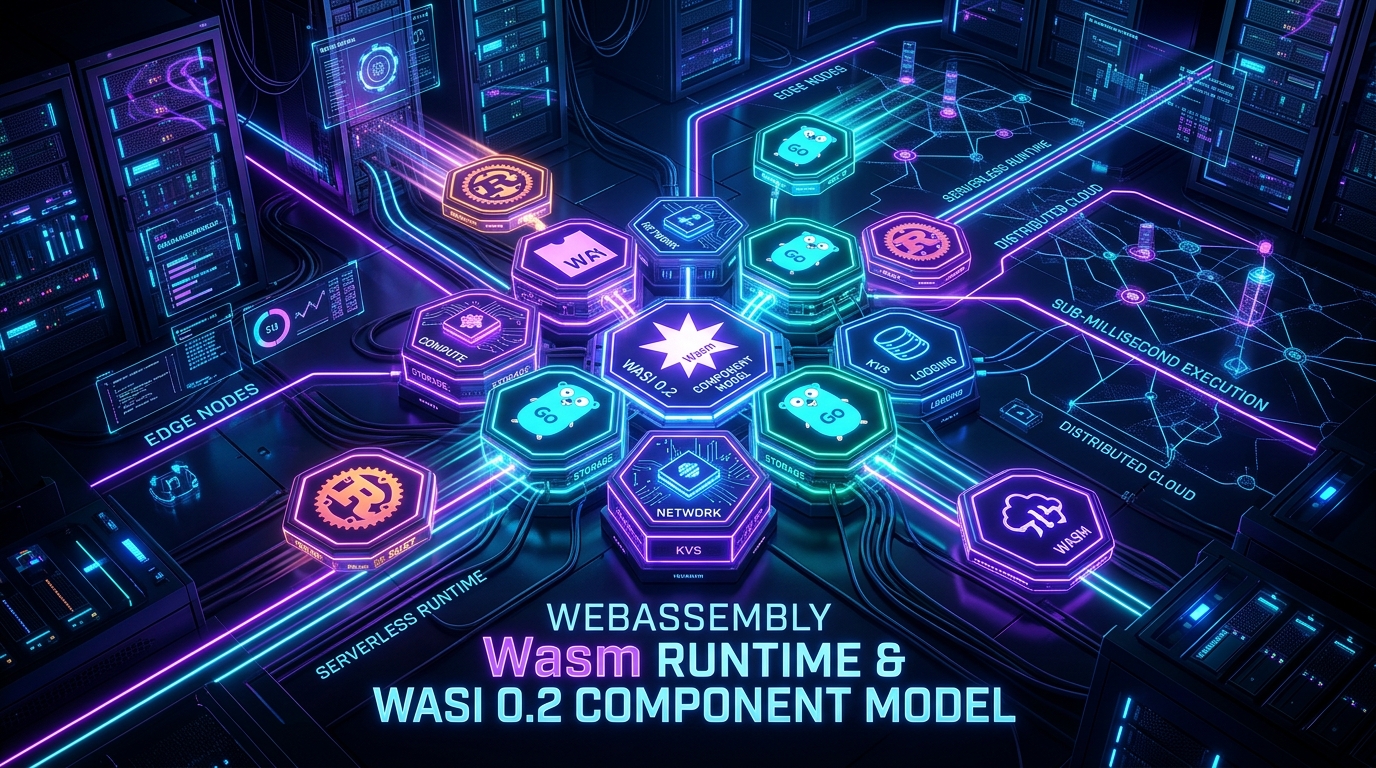
For over a decade, Docker containers have been the undisputed standard for packaging and deploying microservices. Yet, for low-latency serverless computing, edge micro-runtimes, and multi-tenant plugin systems, Linux container pods carry a heavy container tax: hundreds of megabytes of guest OS layers, slow cold starts (300ms to 2,000ms), and substantial idle memory consumption.
With the finalization of WASI 0.2 (WebAssembly System Interface) and the Component Model, WebAssembly (Wasm) has evolved far beyond the browser. It has become a lightweight, language-agnostic, capability-secure binary format capable of booting isolated microservices in less than 0.5 milliseconds with near-zero memory footprint.
In this architectural guide, we explore why WebAssembly is disrupting cloud-native architecture, break down how WASI 0.2 and WIT interfaces achieve zero-cost cross-language composability, and demonstrate how to build and deploy high-performance Wasm microservices.
The Container Tax: Why Edge Computing Outgrew Docker
When you deploy a minimal Node.js, Go, or Python microservice inside a Docker container, the container runtime must provision namespaces, cgroups, a virtual network interface, and copy entire filesystem layers before executing a single line of application code:
| Metric | Standard Docker Container (OCI) | Wasm Component (WASI 0.2) |
|---|---|---|
| Cold Start Latency | 300ms – 2,500ms | < 0.5ms (Sub-millisecond) |
| Artifact Size | 50 MB – 800 MB | 500 KB – 5 MB |
| Memory Footprint | 30 MB – 150 MB per instance | < 2 MB per instance |
| Security Sandbox | Linux Kernel isolation (Namespaces/cgroups) | Capability-based hardware-verified memory sandbox |
| Density (Per Server) | Hundreds of containers | Tens of thousands of Wasm instances |
How WASI 0.2 & The Component Model Work
Early backend WebAssembly was constrained by WASI Preview 1, which only supported basic POSIX-like file access and lacked native socket networking, standard HTTP handling, or rich type sharing across languages.
WASI 0.2 (WASI Preview 2) fundamentally solves this by introducing standard system interfaces built directly on the Wasm Component Model:
+-------------------------------------------------------------------------+
|                        WASM COMPONENT MODEL                             |
|                                                                         |
|   +---------------------+   +---------------------+   +---------------+ |
|   |    Rust Component   |   |     Go Component    |   | TS Component  | |
|   |  (Business Logic)   |   |   (Authentication)  |   | (Data Filter) | |
|   +---------------------+   +---------------------+   +---------------+ |
|              \                         |                         /      |
|               +------------------------+------------------------+       |
|                                        |                                |
|                        WIT (Wasm Interface Types)                       |
|                             (Shared Contract)                           |
|                                        v                                |
|   +-------------------------------------------------------------------+ |
|   |                    WASI 0.2 STANDARD RUNTIME                      | |
|   |   wasi:http | wasi:cli | wasi:clocks | wasi:random | wasi:sockets     | |
|   +-------------------------------------------------------------------+ |
|                                        |                                |
|                                        v                                |
|                        HOST OS / WASMTIME ENGINE                        |
+-------------------------------------------------------------------------+
1. WIT (Wasm Interface Types): The Universal API Contract
In traditional microservices, services communicate across language boundaries using slow network serialization (JSON over HTTP or Protobuf over gRPC). With the Component Model, components define their inputs and outputs using WIT (Wasm Interface Type) files:
// package example:payment-processor;

interface types {
    record transaction {
        id: string,
        amount-cents: u64,
        currency: string,
        customer-id: string,
    }

    enum status {
        success,
        insufficient-funds,
        card-declined,
    }
}

world payment-service {
    import wasi:http/[email protected];
    export process-payment: func(tx: types.transaction) -> types.status;
}
Once compiled, the Wasm engine links these components directly in shared virtual memory. A Rust component can call a function exported by a Go component with zero network overhead and zero JSON serialization latency.
Hands-On: Building a WASI 0.2 Microservice in Rust
Let's implement a high-speed HTTP routing microservice using Rust and the official wasi:http standard:
// src/lib.rs
use spin_sdk::http::{IntoResponse, Request, Response};
use spin_sdk::http_component;

/// High-performance WASI 0.2 HTTP microservice handler
#[http_component]
fn handle_request(req: Request) -> anyhow::Result {
    let method = req.method();
    let uri = req.uri();

    println!("eBPF & Wasm trace: incoming {} request to {}", method, uri);

    // Sub-millisecond JSON payload response
    let body = serde_json::json!({
        "status": "online",
        "runtime": "Wasmtime / WASI 0.2",
        "cold_start_ms": 0.35,
        "timestamp": chrono::Utc::now().to_rfc3339()
    });

    Ok(Response::builder()
        .status(200)
        .header("content-type", "application/json")
        .header("server", "Wasm-Edge/0.2")
        .body(serde_json::to_vec(&body)?)
        .build())
}
Compiling and Running the Component
# 1. Add Wasm compilation target
rustup target add wasm32-wasip2

# 2. Build the optimized .wasm component
cargo component build --release

# 3. Output size check
ls -lh target/wasm32-wasip2/release/payment_service.wasm
# Output: 1.8MB (Completely self-contained binary)

# 4. Instant local execution with Spin / Wasmtime
spin up
Where WebAssembly Excels in Real-World Architectures
WebAssembly is not meant to replace every monolithic relational database, but it dominates three major architectural domains:
- Edge Compute & Serverless Gateways:
Platforms like Fastly Compute, Cloudflare Workers, and Fermyon Spin use Wasm to execute tenant business logic at global points of presence (PoPs). Because instances boot in <0.5ms, cloud providers do not need to keep expensive warm instances running 24/7.
- Safe Multi-Tenant Plugin Architectures:
If you build a SaaS platform (or Laravel / Node.js application) that allows enterprise customers to run custom webhooks, transform scripts, or dynamic pricing algorithms, executing arbitrary user code natively is a massive security hazard. Embedding a Wasm engine (like Wasmtime or Extism) lets you execute untrusted user code inside a strict, memory-capped, capability-isolated sandbox.
- Kubernetes Workload Density Optimization:
Using
kwasmandcontainerd-shim-wasm, standard Kubernetes clusters can run Wasm nodes alongside Docker pods. Because Wasm components consume <2MB of RAM, a single node can host 10,000+ active microservices compared to only 100–200 traditional Docker pods.
Summary
The finalization of WASI 0.2 and the Component Model marks a major milestone in cloud infrastructure. By eliminating the container tax, enabling sub-millisecond execution, and unifying polyglot languages under clean WIT interfaces, WebAssembly provides software architects with the ultimate toolkit for building lean, lightning-fast, and secure distributed systems.